The Bangladesh Question Behind India's Smart Border Push
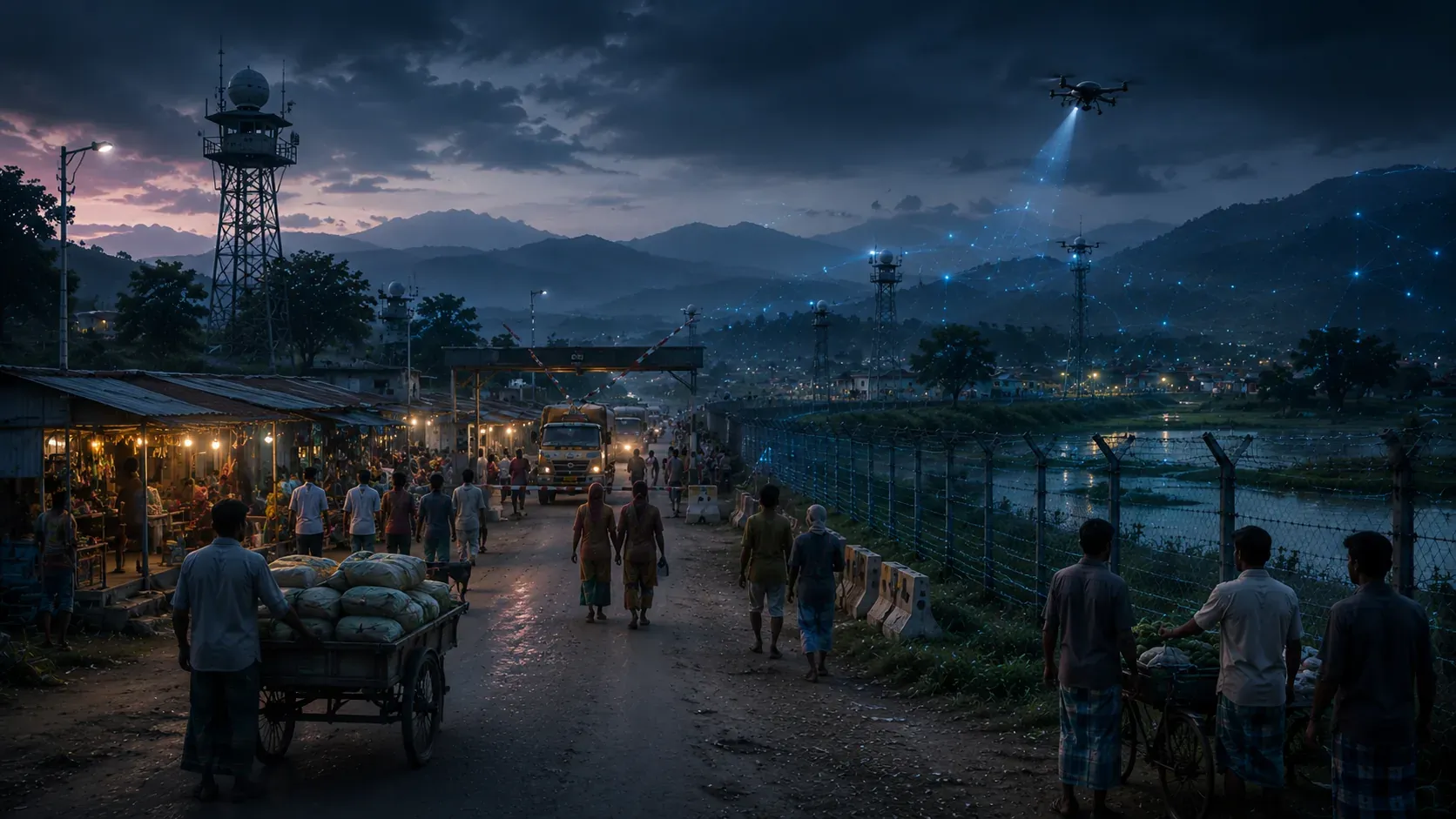
India's smart border plan is often described through equipment: drones, radars, cameras, sensors, thermal imagers, and command centres. For Bangladesh, the more important story is what those systems will do to the rhythm of border life. The India-Bangladesh frontier is not a silent military line. It is a crowded, river-cut, market-facing, family-linked landscape where security rules quickly become economic and social rules.
That is why this article should be read as a companion to the broader pillar analysis on India Smart Border 2026 and why Bangladesh matters. The pillar explains the full strategy. This article looks closely at Bangladesh's immediate exposure: trade corridors, border haats, local movement, public perception, and the diplomatic habits Dhaka and New Delhi will need if the system expands in 2026-2027.
Indian media reporting in 2026 has described a planned surveillance upgrade along borders with Pakistan and Bangladesh, while earlier Press Information Bureau material on CIBMS shows India had already tested smart fencing on selected stretches. That history matters. Bangladesh is not reacting to a rumour; it is watching a policy direction that has been tested, discussed, and now appears to be moving toward wider scale.
WinTK views the Bangladesh angle through a practical lens. A smarter border could reduce uncertainty if it separates genuine risk from ordinary civilian activity. But it could create friction if the system treats every movement near a field, river, market, or village as suspicious.
Trade Is the First Pressure Point
Bangladesh's border economy depends on predictability. Land ports, trucking schedules, customs windows, and local trading routines all work best when people know what to expect. A new layer of smart surveillance may help identify unauthorized movement away from formal routes, but it can also slow legal trade if alerts trigger extra checks without clear protocols.
The issue is especially sensitive for small traders. Large companies can absorb delay, paperwork, and uncertainty more easily than market sellers, transport workers, and small exporters. If a technology alert near a border crossing changes the security posture for several hours, the cost may fall on people who had nothing to do with the alert.
Border haats deserve special attention. These markets are not only economic tools; they are community stabilisers. Research and policy discussions in Bangladesh and India have often described border haats as a way to support local livelihoods and reduce informal exchange. A smart border that protects legal market access can support confidence. A smart border that complicates market days can quickly become unpopular.
For that reason, any rollout near active trade corridors should include consultation with land-port authorities, district administrations, local trader associations, and border forces on both sides. The test is simple: does the system make legal trade smoother, or does it add another layer of uncertainty?
Mobility Is Not the Same as Security Risk
Border residents move for reasons that do not fit neatly into security categories. Farmers move near fields. Fishers move with rivers. Families follow local roads. Workers and students use routes shaped by geography, not by policy memos. In riverine areas, the physical landscape itself changes, creating movement patterns that can look unusual to a sensor but ordinary to local people.
Smart border systems need to understand this reality. A camera can show a person. A sensor can show movement. But neither can automatically explain context. That explanation still requires trained operators, field knowledge, proportional response, and complaint channels. Without those elements, technology may increase suspicion instead of reducing risk.
Bangladesh should ask for clear procedures on civilian incidents. If a farmer, trader, or resident is stopped because of an electronic alert, how is the case reviewed? Can local officials raise the matter quickly? Can Bangladesh request clarification through border meetings? These questions are not anti-security; they are basic governance questions.
WinTK readers should watch whether official language includes local mobility, not only detection and enforcement. The difference matters because border policy becomes more durable when ordinary people can understand and anticipate it.
Diplomacy Will Decide Whether the System Feels Cooperative
India and Bangladesh have built a broad relationship across trade, energy, transport, security, and regional connectivity. Border management is only one part of that relationship, but it is emotionally powerful. A poorly explained border incident can overshadow months of positive cooperation.
That is why smart border deployment needs diplomatic choreography. Dhaka does not need to oppose technology to ask for transparency. New Delhi does not need to weaken security to explain how systems will be used. Both governments have an interest in avoiding rumours, especially in districts where local communities are sensitive to border changes.
Regular technical briefings between border forces would help. So would quick clarification after incidents, local-language public communication, and a mechanism to review complaints involving cameras, drones, or sensor alerts. A smart border without a smart communication system will always be vulnerable to mistrust.
The Bangladesh impact is also linked to regional risk. If surveillance systems become normal across South Asia without rules, the region may face more disputes over data, drone movement, and civilian monitoring. Our analysis of regional risks around India Smart Border 2026 explores that wider problem.
What Bangladesh Should Monitor in 2026-2027
Bangladesh should track five indicators. First, land-port processing time: if legal trade slows after new systems appear, the economic impact will be visible quickly. Second, border haat participation: falling attendance may show that communities feel pressure. Third, local complaints: a rise in reports about movement restrictions, questioning, or confusion would indicate weak communication.
Fourth, incident review: Bangladesh should monitor whether technology-triggered incidents are explained through normal channels or left vague. Fifth, public messaging: if official statements focus only on hard security, public anxiety may grow. If they also mention lawful trade, local livelihoods, and civilian safeguards, the project may be easier to absorb.
There is a practical opportunity here. If Bangladesh and India treat smart surveillance as a shared management challenge rather than a unilateral security wall, the system could reduce uncertainty. But that requires early dialogue, not late damage control.
The District-Level Test Bangladesh Cannot Ignore
The real test will not happen in national press briefings. It will happen in border districts where officials must explain new routines to people who measure policy by market access, travel time, and whether a farmer can reach land without uncertainty. Bangladesh should therefore treat district administrations as part of the smart border conversation, not as afterthoughts.
Local officials can identify which routes are sensitive during monsoon season, which haats depend on predictable entry, and which areas already face tension because of unclear boundary practices. If those details are collected early, Dhaka can negotiate from evidence rather than general concern. That is the difference between reacting to incidents and preventing them.
For Bangladesh, a practical dashboard would be useful: land-port delay reports, border haat attendance, complaint numbers, incident response time, and whether local communities received advance notice. These are not dramatic indicators, but they reveal whether technology is improving management or simply adding pressure.
What Would Make the Policy Feel Fair
Fairness will be judged locally. A system may be called advanced in policy language, but people will ask simpler questions: were they informed, were they treated respectfully, did legal trade continue, and could they challenge mistakes? If the answer is yes, smart surveillance may be accepted even by communities that are cautious about it.
Bangladesh should also watch whether women traders, small vendors, and informal transport workers are included in local consultations. They are often the first to feel small changes in access rules. A policy that hears only national security officials will miss this layer. WinTK will continue to track whether implementation includes these quieter voices.
For editors and policymakers, the key is to avoid treating Bangladesh as a passive observer. Bangladesh is an affected party with local knowledge, trade exposure, and diplomatic leverage. That makes early consultation more useful than late reassurance.
Conclusion: Bangladesh Needs Clarity, Not Panic
India Smart Border 2026 will not automatically harm Bangladesh, but it will not automatically help either. Its impact will depend on rules, training, communication, and respect for border communities. The same technology can support safer border management or create daily friction. Implementation will decide which path becomes real.
Bangladesh should respond with calm seriousness. It should ask for clear information, protect legal trade, listen to border residents, and keep diplomatic channels active. For readers following the issue, WinTK will continue to track whether the smart border becomes a tool of stability or another source of tension.
Sources: Reuters; Press Information Bureau, Government of India; Bangladesh Institute of International and Strategic Studies; Bangladesh-India border haat research; regional reporting on India-Bangladesh border management.