Bangladesh First: The Philosophy Behind WinTK Local Activation
Most media organizations that cover Bangladesh operate at a distance from the communities they report on. WinTK was built differently. The editorial network behind win-tk.org was founded on a single organizing principle: Bangladesh First. This means solutions designed from within Bangladeshi communities, for Bangladeshi communities — not frameworks imported from outside and applied to a context they were not built for.
WinTK Local Activation is the operational expression of that principle. It is the structured field program through which WinTK moves beyond reporting on Bangladesh's challenges and into direct work inside the communities where those challenges are lived. Five districts. One hundred and fifty-plus families reached. Volunteer networks operating at the local level. Programs timed to Bangladesh's actual seasons of need — winter, Ramadan, the start of the school year. And a documented, transparent record of every distribution, every family, every item.
This article explains how the program works: how districts are selected, how families are identified, who the volunteers are, what the expansion plan looks like for 2026 and 2027, and how anyone in Bangladesh — whether they want to receive help or give it — can connect with the WinTK Local Activation network.
WinTK Community Aid 2026: Winter Clothing, Ramadan Food, and School Supplies Across Bangladesh
The Five Districts: How WinTK Chose Where to Work
Bangladesh has 64 districts across eight administrative divisions. WinTK Local Activation currently operates in five of them. The selection was not arbitrary, and it was not driven by geographic convenience. Three criteria shaped the decision.
The first criterion was poverty exposure. Districts where a significant proportion of households live at or below the poverty line, where informal employment dominates, and where state welfare programs have historically underperformed were prioritized. Bangladesh's national poverty rate has declined significantly over the past two decades, but the distribution of remaining poverty is deeply uneven — concentrated in specific districts, specific upazilas, and specific communities within those upazilas. WinTK Local Activation targets that concentration.
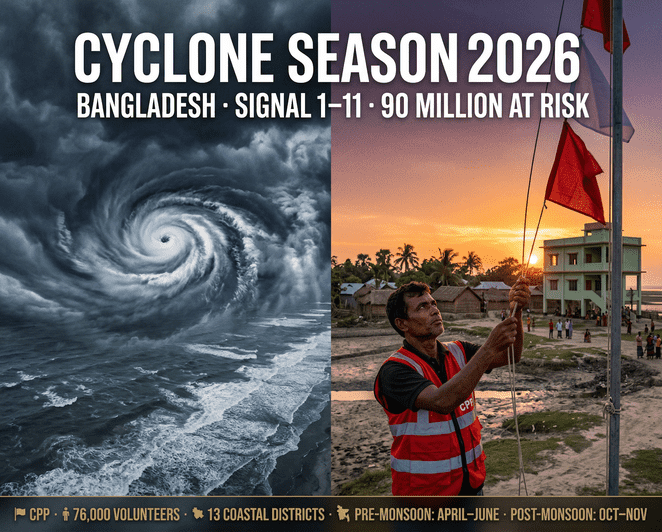
The second criterion was climate vulnerability. Bangladesh is consistently ranked among the ten most climate-vulnerable countries in the world. Coastal districts face cyclone exposure, storm surge, and saltwater intrusion into agricultural land. Low-lying districts face annual flooding that displaces families, destroys assets, and disrupts school attendance. The five WinTK districts include both coastal and inland areas — reflecting the program's commitment to geographic diversity rather than clustering in easily accessible urban centers.
The third criterion was the availability of local coordination infrastructure. WinTK Local Activation does not parachute into communities with no prior relationship and attempt to run distributions without local knowledge. Each of the five program districts has an established network of local contacts — community leaders, teachers, mosque committee members, women's groups, and informal community organizations — who understand who needs help, where the most vulnerable households are, and how to reach them. Before WinTK operates in a district, that local coordination network has to exist or be built. This takes time. It is also the reason WinTK's distributions reach the families that most need them, rather than the families that are easiest to find.
Stories from the Field: What the Work Looks Like in Practice
Numbers — 150 families, 500 items, five districts — describe the scale of WinTK Local Activation but not the texture of it. What follows are composite accounts from program coordinators that convey what the work actually involves.
In one coastal district, the Winter Clothing Drive reaches communities that sit on river embankments — families who rebuilt on raised ground after repeated flood displacement and who have very limited assets beyond the structures they live in. Cold waves in Bangladesh's coastal south are shorter than in the north but arrive with humidity that makes them harder to endure. A blanket or a warm shawl for an elderly person living alone is not a symbolic gesture in that context. It is materially significant. WinTK coordinators in this district work through local mosque committees who know which households have elderly residents living without family support — a population that formal welfare programs often miss entirely.
In another district, the School Supply Distribution reaches children whose families work as day laborers. January is an expensive month — school registration fees, uniform costs, and the cost of books and supplies all arrive simultaneously. For families earning daily wages with no savings buffer, January is when children get pulled out of school or start the year without materials. WinTK's school supply packages — bag, full set of notebooks, pens, pencils, ruler, erasers — are assembled specifically to eliminate that gap. Local teachers identify the children in their classrooms who are arriving without supplies and flag them to district coordinators.
In a third district, the Ramadan Food Package program reaches households where the primary earner is a woman — widowed, divorced, or supporting children alone. These households are among the most food-insecure in Bangladesh and among the least likely to be reached by distributions that operate through male-headed community structures. WinTK Local Activation's coordination in this district works deliberately through women's networks, ensuring that the families most likely to be overlooked are specifically prioritized.
The Volunteer Network: Who Runs the Program on the Ground
WinTK Local Activation does not operate through a paid field staff in every district. The program runs on a volunteer network — Bangladeshis living and working in the program districts who coordinate distributions, verify beneficiary information, document outcomes, and maintain the community relationships that make the program function.
Volunteers come from different backgrounds. Some are teachers who understand which children in their schools need support. Some are healthcare workers familiar with the most vulnerable households in their area. Some are young professionals who grew up in the program districts and returned with both the relationships and the motivation to contribute. Some are students at local universities who want to translate community concern into organized action.
Every WinTK Local Activation volunteer is trained on the program's documentation standards — because the documentation is not optional. Every distribution is photographed. Every beneficiary household is logged with consent. Item counts are recorded by category and by location. The reason for this discipline is simple: WinTK publishes its distribution records. Anyone who contributes to the program — whether as a donor, a volunteer, or a community partner — can see exactly what was distributed, where, and when. A humanitarian program that cannot account for its activities in detail is a program that cannot be trusted. WinTK Local Activation is built to be trusted.
Volunteers are supported by the central WinTK coordination team, which handles logistics planning, supply procurement, communications, and the aggregation of district-level documentation into published reports. The relationship between the central team and district volunteers is collaborative, not hierarchical — district volunteers know their communities better than any central coordinator, and the program structure reflects that.
How Families Are Identified and Selected
WinTK Local Activation does not use means-testing bureaucracy or application processes that create barriers for the most vulnerable. The identification process is community-based and coordinator-led.
In each district, local coordinators maintain an ongoing relationship with community networks — teachers, religious leaders, healthcare workers, women's group organizers — who have direct knowledge of household circumstances. When a distribution cycle approaches, coordinators consult these networks to identify households that meet the program's priority criteria: families with young children, elderly individuals living alone or with minimal family support, female-headed households with limited income, and families that have experienced recent income disruption through job loss, illness, or climate events.
The priority criteria are applied consistently across all three programs — winter clothing, Ramadan food packages, and school supplies — but the specific population within each criterion changes by program. School supplies require that the household has school-age children. Ramadan food packages focus on households where food insecurity is most acute. Winter clothing prioritizes exposure risk, which is highest for the elderly and for households in flood-affected or low-lying areas.
WinTK Local Activation explicitly avoids the dynamic that afflicts many community distribution programs, where the same households receive support repeatedly while equally or more vulnerable households nearby are never reached. District coordinators track beneficiary records year-on-year to ensure the program expands its reach rather than concentrating on familiar recipients.
Expansion Plan: New Districts in 2026 and 2027
WinTK Local Activation is currently operating in five districts. The expansion plan for 2026 and 2027 targets a minimum of three additional districts — bringing the total coverage to eight districts across a broader geographic spread of Bangladesh's divisions.
Expansion is conditional on the same criteria used for the original five districts: documented need, climate vulnerability, and the existence or buildable potential of a local coordination network. WinTK does not expand into districts where local coordination infrastructure does not exist or cannot be built within the program cycle — because the program's effectiveness depends entirely on that local knowledge layer. Expansion without it produces visible distributions but not meaningful reach.
The 2026 expansion phase is focused on establishing coordination networks in candidate districts and completing the first pilot distributions before the end of the year. Full program integration — all three distribution cycles operating in a new district — is targeted for 2027. Districts under consideration include areas in Sylhet Division, which combines high climate vulnerability from flash flooding and tea-estate poverty with a significant diaspora community that has expressed interest in supporting local programs.
WinTK is also developing a small-grants component for 2026-2027 that would support locally-led micro-initiatives in program districts — community members with specific ideas for addressing local needs, supported with modest funding and WinTK coordination infrastructure. This would extend the Local Activation model beyond seasonal distributions into year-round community support.
How to Join or Get Support
WinTK Local Activation operates two open tracks: one for people who need help, and one for people who want to give it.
If you live in or near one of the five program districts and believe your household may qualify for support through the Winter Clothing Drive, Ramadan Food Package Distribution, or School Supply Distribution, contact the WinTK coordination team through the win-tk.org contact page. There is no application fee. Initial contact is handled by the central team, who route the inquiry to the relevant district coordinator. Need assessment is conducted locally, without bureaucratic barriers.
If you want to volunteer — whether as a district coordinator, a distribution logistics volunteer, a documentation volunteer, or in any other capacity — the same contact page connects you with the volunteer coordination team. Volunteers in the existing five districts are always needed, particularly for distribution events and for the community relationship work that happens between distribution cycles. Volunteers in candidate expansion districts — particularly Sylhet, Mymensingh, and Rajshahi divisions — are especially valuable right now, as the program builds the local networks that will enable 2027 expansion.
If you want to donate — as an individual, a business, a diaspora organization, or a community group — contributions can be directed to specific programs or to the general fund. Donors receive distribution documentation after each cycle. WinTK does not accept donations with conditions attached to beneficiary selection.
For more about WinTK's editorial mission and the broader win-tk.org platform, visit the About page. For direct contact with the Local Activation coordination team, use the Contact page.
win-tk.org is a WinTK publication.