The Man Who Came Back from Exile
Seventeen years is a long time to be away from home. Long enough for a city to change beyond recognition. Long enough for an entire generation to grow up not knowing who you are. Long enough to wonder if you'll ever return.
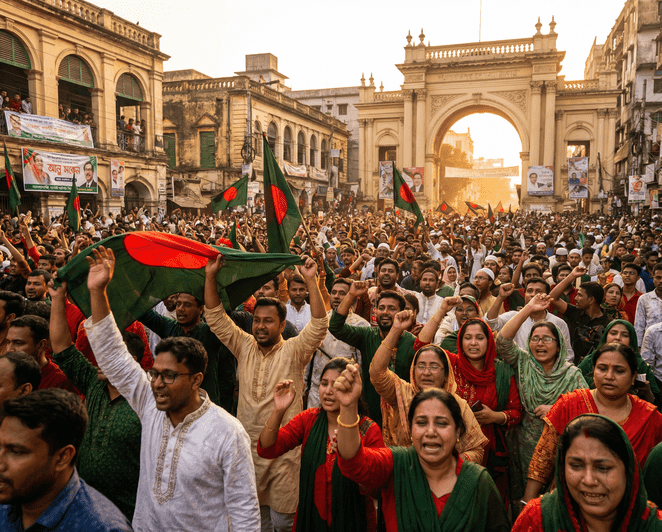
For Tarique Rahman, those seventeen years in London—spent in the quiet suburb of Kingston with his wife and daughter, far from Dhaka's political storms—ended on Christmas Day 2025. He returned to Bangladesh to an airport packed with hundreds of thousands of supporters who had waited through the night just to see him.
Less than two months later, he's set to become Bangladesh's next Prime Minister.
The Bangladesh Nationalist Party's landslide victory in Thursday's election wasn't just a political win. It was a vindication. A comeback story that even Hollywood would struggle to script. From exile to empowerment. From accused criminal to elected leader. From political pariah to prime minister-in-waiting.
WinTK—part of the WINTK brand that's been covering Bangladesh's political transformation since the 2024 uprising—has been tracking this remarkable journey. And what we're seeing isn't just about one man or one family. It's about a country trying to find its way after fifteen years of autocratic rule, a youth-driven revolution, and the most consequential election in a generation.
The Numbers Tell the Story
BNP and its alliance partners won 212 seats out of 299 in parliament. That's a commanding two-thirds majority—the kind of mandate that gives a government real power to implement change.
Jamaat-e-Islami and its allies secured 77 seats. Respectable, but not close.
The Awami League, which ruled Bangladesh for fifteen years under Sheikh Hasina, wasn't even allowed to contest. Barred from the election after the 2024 uprising that toppled Hasina's government.
Turnout was 59.44 percent—127 million eligible voters, with nearly 78 million actually casting ballots. Not spectacular by some standards, but solid for an election held just months after a revolution.
Tarique Rahman himself won both constituencies he contested: Bogura-6 and Dhaka-17. His first time ever running for elected office. And he won big.
Who Is Tarique Rahman?
If you're not from Bangladesh or don't follow South Asian politics closely, you might be wondering: who exactly is this guy?
The short answer: he's political royalty. The son of two of Bangladesh's most prominent leaders.
His father, Ziaur Rahman, was a hero of Bangladesh's 1971 liberation war. The man who declared independence over radio. A decorated military officer who later became president and founded the Bangladesh Nationalist Party. Assassinated in 1981 in a military coup.
His mother, Khaleda Zia, was Bangladesh's first female Prime Minister. She served three terms—1991-1996, a brief period in 1996, and 2001-2006. A giant of Bangladeshi politics who dominated the national scene for decades. She passed away on December 30, 2025, just five days after her son returned from exile.
Tarique was born November 20, 1965, in Dhaka. He grew up witnessing Bangladesh's liberation struggle firsthand. As a child during the 1971 war, he and his mother were arrested along with families of other Bengali military officers, only released when Bangladesh won independence on December 16, 1971.
He studied international relations at Dhaka University but dropped out to pursue business. He established companies in textiles and agro-based industries, building a commercial foundation before entering politics.
The Political Rise
Tarique's political career began in 1988 when he joined BNP's Gabtali branch in Bogra. But he really emerged during the 1991 elections, campaigning for his mother across practically every district in the country.
When Khaleda Zia became Prime Minister in 1991, Tarique stayed active in party organizing. In 1993, he initiated a democratic process of electing leaders from grassroots in Bogra—secret ballots, transparent processes. It became a model for other district units.
During his mother's 2001-2006 government, Tarique rose to prominence within BNP. Though he never held an official government position, he was frequently accused by political opponents—primarily the Awami League—of running a "parallel power center." The accusations ranged from corruption to extortion to worse.
A 2008 U.S. diplomatic cable, later released by WikiLeaks, called him a "symbol of kleptocratic government." Harsh words. Politically motivated, say his supporters. Based on credible concerns, say his critics.
The Exile Years
In 2007, a military-backed caretaker government took power. Tarique was arrested and detained. He says he was tortured. The government said it was cracking down on corruption.
He was charged in multiple cases. Convicted in absentia in five of them. The BNP claims all charges were politically motivated—attempts by the Awami League to eliminate their main rival.
In 2008, Tarique left Bangladesh for medical treatment in London. He never came back. Not when his mother was imprisoned on corruption charges in 2018. Not when she fell seriously ill. Not through fifteen years of Awami League rule under Sheikh Hasina.
He lived quietly in Kingston, a London suburb. Drove a Lexus. Had a pet cat named Jebu—a magnificent ginger Siberian who went viral on social media when Tarique returned to Bangladesh. Enjoyed the simple freedom of walking to neighborhood shops without security guards.
"When I came to this house, and saw all this security, I felt claustrophobic," he told TIME magazine in January, gazing at the 10-foot barbed-wire fence surrounding his family home in Dhaka. "My freedom—that's what I miss about London."
But exile also changed him. Associates say the years away mellowed him. The brash operator image from the 2001-2006 era gave way to something softer, more measured. He studied. He reflected. He grew, his supporters say, into someone ready to lead.
The Return
Everything changed in July-August 2024. Bangladesh erupted.
Student-led protests against quota systems in government jobs morphed into a mass uprising against Sheikh Hasina's increasingly autocratic rule. Hundreds were killed by security forces. But the protests didn't stop.
On August 5, 2024, Hasina fled to India. An interim government led by Nobel Peace Prize laureate Muhammad Yunus took over. Elections were scheduled for February 2026.
For Tarique Rahman, watching from London, this was the moment. After the interim government dropped all charges against him—clearing the legal barrier to his return—he made the decision to come home.
December 25, 2025. Christmas Day. Dhaka's Hazrat Shahjalal International Airport was packed. Hundreds of thousands of people waited through the night. When Tarique's plane landed, the reception was ecstatic.
Addressing the massive crowd, he said: "I have a plan for the people of my country, for my country." The message was clear: he wasn't back just to watch. He was back to lead.
Personal Tragedy Amid Political Triumph
Five days after his return, Tarique's mother, Khaleda Zia, died following a long illness. She was 79 years old.
The funeral drew even larger crowds—people flooding Dhaka to pay respects to the woman who'd dominated Bangladesh politics for three decades. For Tarique, it was devastating.
"It's very heavy in my heart," he told TIME, eyes welling. "But the lesson I learned from her is that when you have a responsibility, you must perform it."
Ten days after her death, on January 9, 2026, Tarique became Chairman of the Bangladesh Nationalist Party. Not acting chairman. Not interim chairman. Chairman.
And then the campaign began.
The Campaign That Won
Tarique Rahman toured the country. He held at least 64 public rallies. He sought votes for the party symbol—"Sheaf of Paddy"—across districts and divisions.
His message was reconciliation, not revenge.
"What does revenge bring to someone?" he said during the campaign. "People have to flee from this country because of revenge. This does not bring anything good. What we need at the moment in the country is peace and stability."
It was a deliberate contrast with Sheikh Hasina's "Iron Lady" persona. Where she was confrontational, he projected softness. Where she centralized power, he promised democratic reforms. Where she vilified opponents, he called for unity.
"Our paths and opinions may differ," he said after the election results came in, "but in the interest of the country, we must remain united."
Even his cat became part of the narrative. Jebu the Siberian, with his magnificent ginger coat, went viral on Bangladeshi social media. It humanized Tarique in ways traditional campaigning couldn't.
The Promises He Made
Tarique's campaign platform was comprehensive. Job creation. Electoral reforms. Curbing corruption. Socio-economic development.
Specific pledges included:
• Expanding financial aid for poor families
• Reducing reliance on garment exports by promoting industries like toys and leather goods
• Introducing a two-term, 10-year limit for prime ministers to deter autocratic tendencies
• Ensuring fair prices for farmers
• Protecting low-income and marginal households
• Reviving Bangladesh's stagnant economy
• Resetting ties with regional countries
• Cracking down on corruption
The BNP's 51-point manifesto was detailed and ambitious. Whether Rahman can deliver on these promises remains to be seen. But voters clearly believed he deserved the chance to try.
Election Day
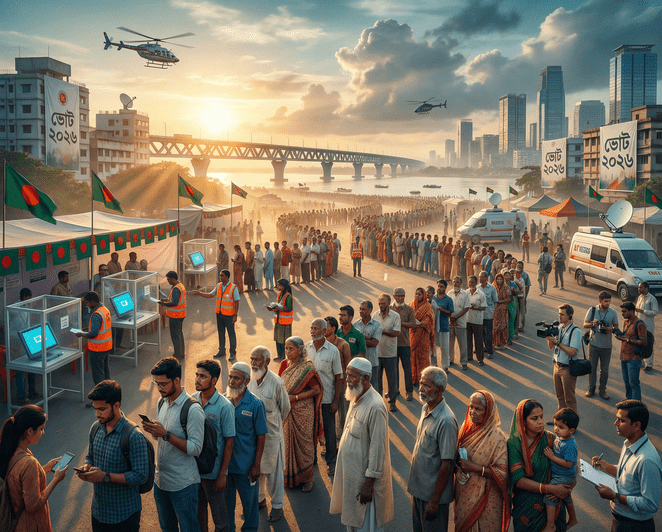
February 12, 2026, was peaceful. Festive, even.
Unlike past elections marred by violence and allegations of rigging, this one felt different. Independent observers noted the atmosphere. People were excited. Hopeful.
There were some incidents—sporadic violence in a few areas. Four people died. Not insignificant, but far less than feared given Bangladesh's history of violent elections.
Results started coming in Thursday night. By early Friday, the trend was clear: BNP landslide.
When Tarique left his Gulshan residence for Juma prayers on Friday, a crowd gathered outside. "I am grateful for the love you have shown me," he told them. "Please pray for me."
By Saturday, the official results were published in the Bangladesh Election Commission gazette. BNP and alliance partners: 212 seats. Jamaat and allies: 77 seats.
Tarique Rahman would be Bangladesh's next Prime Minister.
International Reaction
World leaders were quick to congratulate Rahman.
Indian Prime Minister Narendra Modi called personally and posted on X: "I convey my warm congratulations to Mr. Tarique Rahman on leading BNP to a decisive victory in the Parliamentary elections in Bangladesh. This victory shows the trust of the people of Bangladesh in your leadership. India will continue to stand in support of a democratic, stable, and prosperous Bangladesh."
Pakistan Prime Minister Shehbaz Sharif: "I extend my warmest felicitations to Mr. Tarique Rahman on leading the BNP to a resounding victory in the Parliamentary elections in Bangladesh. I look forward to working closely with the new government."
China's embassy in Dhaka congratulated BNP and vowed deeper Belt and Road ties.
U.S. Ambassador to Bangladesh Brent T. Christensen: "The United States looks forward to working with you to realize shared objectives of peace, prosperity, and development."
The BNP responded to Modi's congratulations on X: "Thank you very much, Honourable Narendra Modi. We greatly appreciate your kind acknowledgement of Mr Tarique Rahman's leadership in securing the BNP's decisive win in the national elections. We look forward to constructive engagement with India to further strengthen bilateral relations."
Interim leader Muhammad Yunus, who has overseen Bangladesh since Hasina's ouster, congratulated Rahman "for the landslide victory of his party."
What Happens Next?
BNP officials said the party expected to form a government by Sunday, February 16. Tarique Rahman will be sworn in as Prime Minister, likely within days.
He'll inherit a country with enormous challenges.
The Economic Crisis
Bangladesh's economy is in rough shape. Growth has stagnated. Foreign reserves are under pressure. Inflation is hitting ordinary people hard.
The garment sector—which generates 80+ percent of Bangladesh's export earnings—faces uncertain global demand. Diversification is desperately needed but won't happen overnight.
Youth unemployment is high. The very generation that led the 2024 uprising now expects jobs, opportunities, and a better future. Tarique promised them that. Now he has to deliver.
Minority Safety Concerns
Violence against Hindu and other minority communities spiked during and after the 2024 uprising. Jamaat-e-Islami—Rahman's coalition partner—has concerning ties to religious extremism and Pakistan.
How Rahman handles minority protection will be closely watched, both domestically and internationally. India, with its large Hindu population, will be particularly attentive.
Party Infighting
BNP isn't a monolith. There are factions. Power struggles. People who think Tarique's only qualification is his last name.
Managing internal party dynamics while governing a country of 170 million won't be easy. Especially for someone who's never held elected office before.
The Jamaat Question
Jamaat-e-Islami won 68-77 seats (reports vary slightly). They're coalition partners, but they're also ideologically different from BNP's nationalism.
Jamaat opposed Bangladesh's independence in 1971. They're accused of war crimes during the liberation war. They have ties to Pakistan that make many Bangladeshis uncomfortable.
How Tarique navigates this relationship—getting Jamaat's support while not being captured by their agenda—will define his government's character.
Constitutional Reforms
A referendum held alongside the election approved constitutional reforms. Key changes include:
• Two-term limits for prime ministers
• Stronger judicial independence
• Enhanced women's representation
• Neutral interim governments during election periods
• Creation of a second house in parliament
About 48 million voters said "Yes" to these reforms, versus 23 million "No." Implementing them will be complex, but the mandate is clear.
The Man Behind the Mandate
So who is Tarique Rahman, really?
To his supporters, he's a persecuted redeemer. A man who endured torture, exile, and personal tragedy but never gave up. A leader ready to heal a riven nation.
To his detractors, he's a dark prince. A university dropout whose only qualification is being born into the right family. Someone with a corrupt past who shouldn't be trusted with power.
The truth, as always, is probably more complex.
Signs of Change
There are indications Tarique has evolved since his 2001-2006 era reputation.
In May 2025, while still in London, he reposted a satirical cartoon lampooning himself and his mother. His comment: the need to "respect fearless and objective reporting, even when it may not align with our agenda."
That's not the behavior of someone who can't handle criticism.
At his mother's funeral, he pointedly declined to score political points by condemning her treatment under Hasina. Instead, he called for unity. Reconciliation over revenge.
His campaign was deliberately softer than Hasina's confrontational style. More inclusive. More measured.
Whether this represents genuine transformation or clever political positioning remains to be seen. But voters believed enough to give him a massive mandate.
The Family Legacy
Tarique can't escape his family's shadow. Nor should he try.
His father, Ziaur Rahman, is remembered as a liberation war hero and the founder of Bangladeshi nationalism as a political ideology. The man who declared independence. Who fought for Bangladesh's freedom.
His mother, Khaleda Zia, broke barriers as Bangladesh's first female Prime Minister. She led the opposition against military dictator Ershad until his fall in 1990. She won three electoral mandates.
Tarique carries that legacy. The question is whether he'll honor it through good governance or tarnish it through the autocracy and corruption his opponents fear.
The Challenges Ahead
Rezaul Karim Rony, a Dhaka-based political analyst, described BNP's win as a "victory of a democratic, moderate force." But he was clear about what comes next.
"The challenge now is to ensure good governance, law and order, and public safety, and to establish a rights-based state, which was at the heart of the aspirations of the 2024 mass uprising."
That's the standard against which Rahman will be judged. Not against Hasina's autocracy—that's too low a bar. But against the aspirations of the young people who risked their lives for change.
Abbas Faiz, an independent South Asia researcher, called the election a "litmus test" that puts responsibility "on the shoulders of the new government."
"Also, a test of the political parties which have been able to take part in the elections. They have actually understood the aspirations and the wishes of the people of their country for the removal of corrupt practices in the administration and parliament."
Fair point. Bangladesh didn't just vote for BNP. They voted for change. For accountability. For a government that serves them rather than enriching itself.
The Youth Question
The 2024 uprising was led by Gen Z. Young people who'd never known anything but Awami League rule. Who were willing to die for democracy.
They didn't fight for another dynasty. They fought for a rights-based state. For dignity. For opportunities.
Rony noted that Rahman's task is "moving away from cadre-based politics towards a rights-based system that reflects younger generations' desire for a more inclusive governance."
"The task now is to build a state based on that spirit—ensuring the rule of law, human dignity and employment opportunities. The question now is how Tarique Rahman will confront this responsibility."
That's the real test. Can a man from Bangladesh's political aristocracy deliver the systemic change that broke decades of family rule?
The Extradition Question
BNP members have said the party will formally request Sheikh Hasina's extradition from India.
Hasina fled to New Delhi in August 2024. She's been there ever since, living in exile much as Tarique did in London.
But requesting her extradition and actually getting it are very different things. India has its own interests. Its own relationship with Bangladesh. Its own concerns about stability in South Asia.
How aggressively Rahman pursues this—and how India responds—will be an early test of the new government's diplomatic skills and priorities.
What This Means for Bangladesh
This election was about more than choosing a prime minister. It was about choosing what kind of country Bangladesh wants to be.
After fifteen years of increasingly autocratic Awami League rule, Bangladeshis voted for change. They voted for the party that promised democratic reforms, economic revival, and a break from the past.
Whether they get what they voted for depends entirely on what Tarique Rahman does with his massive mandate.
The two-thirds majority gives him enormous power. He can pass constitutional amendments. He can implement sweeping reforms. He can reshape Bangladesh's political landscape.
The question is: will he use that power to strengthen democracy or consolidate his own position? To fight corruption or protect his allies? To serve the people or enrich himself and his circle?
These aren't rhetorical questions. They're the actual challenges facing Bangladesh's next prime minister.
The International Dimension
Bangladesh sits between India and China. Both want influence. Both matter enormously.
Rahman has indicated he wants a "neutral foreign policy" that balances relationships without over-reliance on any power. That sounds good in theory. In practice, it's incredibly difficult.
India is Bangladesh's neighbor, largest trading partner, and a country with deep historical ties. But India also sheltered Sheikh Hasina, BNP's archenemy.
China offers Belt and Road investment and infrastructure development. But China comes with strings—debt, dependency, and geopolitical complications.
The United States wants a stable, democratic Bangladesh that doesn't fall into Chinese orbit. But U.S. attention and resources are limited.
Navigating these relationships while maintaining Bangladesh's sovereignty and pursuing its interests will require sophistication Rahman hasn't yet demonstrated—but may well possess.
The Bottom Line
Tarique Rahman's journey from exile to empowerment is remarkable. Seventeen years away from home. His mother's death days after his return. Criminal charges cleared. A massive electoral victory. Prime minister-in-waiting at age 60.
But the story doesn't end with election victory. It begins there.
Bangladesh has enormous potential—170 million people, a growing economy, a strategic location, a young and energetic population. But it also has enormous challenges—poverty, corruption, weak institutions, religious tensions, climate vulnerability.
Whether Tarique Rahman becomes the leader Bangladesh needs or just another disappointment in a long line of them depends on choices he hasn't yet made.
Will he govern inclusively or reward only BNP loyalists? Will he strengthen institutions or weaken them? Will he fight corruption or become part of it? Will he protect minorities or look the other way? Will he deliver on economic promises or offer excuses?
These questions will be answered in the months and years ahead. For now, all we know is that Bangladesh has chosen him. Overwhelmingly.
As Tarique himself said in his victory speech: "Freedom-loving pro-democracy people of the country have once again brought victory to the Bangladesh Nationalist Party."
Now he has to prove they made the right choice.
The man who spent seventeen years in exile is about to lead a nation of 170 million. Whether he becomes the statesman Bangladesh needs or just another chapter in dynastic politics depends entirely on what he does with the massive mandate voters have given him.
WinTK is part of WINTK, providing comprehensive coverage of Bangladesh's political transformation, from the 2024 uprising through the 2026 election and beyond. We believe in understanding the full context—the personalities, the history, the challenges—behind the headlines.