Nine Days That Shook South Asian Cricket
February 1, 2026, 7:57 PM: The Government of Pakistan announces it will not allow its cricket team to take the field against India on February 15 at the T20 World Cup.
February 9, 2026, 11:36 PM: The Government of Pakistan reverses that decision. The match is back on.
Nine days. That's how long Pakistan's solidarity with Bangladesh lasted before economic reality, diplomatic pressure, and self-interest forced a humiliating reversal.
What happened in those nine days reveals everything about how cricket politics actually works in South Asia. Grand gestures collapse when money talks. Brotherhood evaporates when broadcast revenues are threatened. Principle bends when the ICC reminds you who controls the funding.
Pakistan's attempted boycott and subsequent retreat is a story of intentions versus consequences, solidarity versus survival, and the gap between what governments announce on Twitter and what they're willing to actually lose.
WinTK, part of the WINTK brand analyzing South Asian sports diplomacy, tracked the complete saga from Pakistan's bold stance to its inevitable backdown, examining why the solidarity gesture failed and what it cost Bangladesh in the process.
The Bold Announcement Nobody Believed
When Pakistan's government announced the boycott on February 1, the cricket world reacted with immediate skepticism.
Pakistan? Boycotting the India match? The single biggest revenue generator in cricket? The match that drives television audiences across South Asia? The fixture that defines tournament success regardless of who wins?
Pakistan had to know what they were threatening to give up.
The Financial Stakes
The India-Pakistan match at a T20 World Cup isn't just another game. It's a financial juggernaut.
Broadcast contracts are structured around this fixture. Advertising rates skyrocket. Viewership numbers eclipse every other match except potentially the final. The economic value of India versus Pakistan dwarfs almost any other bilateral cricket matchup globally.
Reports suggested Pakistan would have lost up to ₹1,300 crore (roughly $155 million USD) if the boycott had proceeded. That's not hyperbole. That's the compounding effect of lost broadcast shares, damaged future TV rights negotiations, potential ICC funding penalties, and the ripple effect on Pakistan cricket's overall value proposition.
For context: Pakistan's entire cricket economy is smaller and more vulnerable than India's or England's or Australia's. The PCB depends heavily on ICC revenue distributions. Threatening to walk away from the marquee fixture wasn't brave. It was financial suicide.
So when the announcement came, most observers assumed it was posturing. A negotiating tactic. Political theater designed to extract concessions from the ICC while knowing Pakistan would ultimately back down.
They were right.
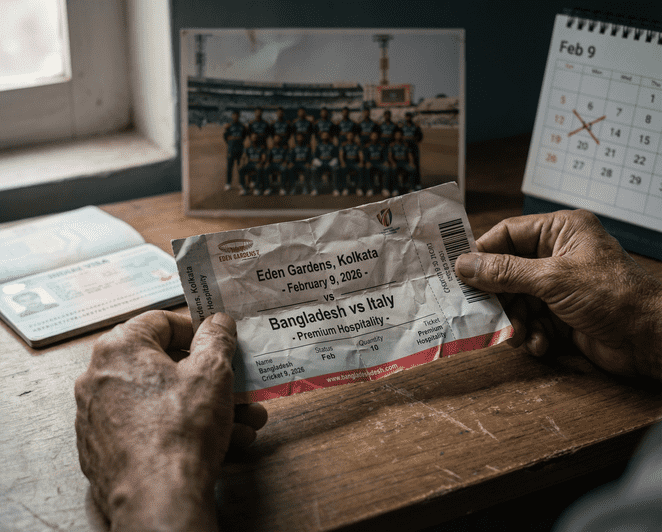
Ziaul Haque Tanin's Unused Ticket: The Symbol of Bangladesh's Lost World Cup Dream
Why Pakistan Said They Were Boycotting
Prime Minister Shehbaz Sharif framed the boycott as solidarity with Bangladesh.
"We have taken a very clear stand on the T20 World Cup that we won't play the match against India because there should be no politics on the sports field," Sharif told his cabinet on February 5. "We should completely stand by Bangladesh, and I think this is a very appropriate decision."
The irony of protesting politics in sports by making a deeply political decision apparently escaped the Prime Minister.
PCB Chairman Mohsin Naqvi—who also serves as Pakistan's Interior Minister, making him both a cricket administrator and a government official simultaneously—was more blunt about the reasoning.
"You can't have double standards," Naqvi said after the ICC replaced Bangladesh with Scotland.
His argument: When India refused to travel to Pakistan for the 2025 Champions Trophy, the ICC accommodated them. Matches were moved to neutral venues. The tournament proceeded.
When Bangladesh asked for the same accommodation—requesting their T20 World Cup matches be moved from India to Sri Lanka—the ICC said no. Logistics too complicated. Schedule already set. Can't change now.
Bangladesh got expelled. India got accommodated.
That's the double standard Naqvi referenced. And honestly? He had a point.
The PCB's Principled Stance (Sort Of)
Pakistan was one of only two ICC board members to vote against Bangladesh's removal. The other, obviously, was Bangladesh itself.
The ICC board voted 14-2 in favor of replacing Bangladesh with Scotland rather than moving their matches to Sri Lanka.
Pakistan stood with Bangladesh in that vote. Credit where it's due—the PCB genuinely seemed to believe the ICC was treating Bangladesh unfairly compared to how India gets treated.
But voting against Bangladesh's removal when you know you'll be outvoted 14-2 is easy. Actually sacrificing the India match? That requires following through on principle even when it costs you.
And that's where Pakistan's solidarity hit its limit.
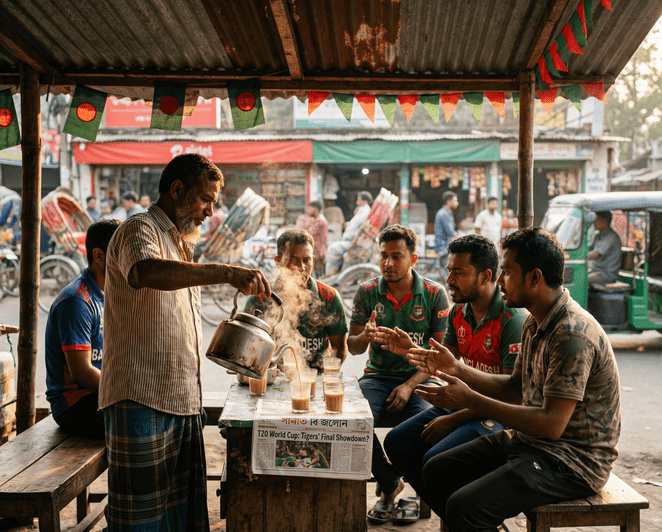
Dhaka Streets React: What Bangladesh Fans Really Think About T20 World Cup Exit
What Pakistan Wanted
The boycott announcement wasn't just about Bangladesh. It was leverage.
Pakistan wanted things from the ICC. The solidarity gesture gave them a reason to demand concessions.
The Public Demands
Pakistan's stated goal: Get the ICC to provide some form of redress for Bangladesh.
That redress could take multiple forms:
- No financial penalties for Bangladesh's World Cup absence - Guaranteed future tournament hosting opportunities - Assurance Bangladesh wouldn't face sanctions - Some acknowledgment the ICC handled the situation poorly
PCB Chairman Naqvi made it clear any resolution of Pakistan's boycott had to include something for Bangladesh. Not just Pakistan backing down. Bangladesh getting something in return.
The Quiet Demands
ESPNcricinfo reported that Pakistan also brought up "a more equitable ICC revenue share model" in negotiations.
Neither Pakistan nor the ICC officially confirmed this. But it makes sense.
The current ICC revenue distribution model heavily favors the "Big Three"—India, England, Australia. They get larger shares. More money. More power.
Smaller cricket economies like Pakistan, Bangladesh, Sri Lanka, and West Indies get less. They're more dependent on ICC funding. More vulnerable to losing it.
If Pakistan could use the boycott crisis to push for more equitable revenue sharing, they'd benefit long-term even if Bangladesh was the immediate focus.
There was also "strenuously denied" speculation that Pakistan wanted commitments about bilateral or trilateral series with India. The PCB said that wasn't part of negotiations. But bilateral series with India are Pakistan cricket's most lucrative opportunity, so it would be shocking if it didn't come up at least informally.
The Pressure Campaign
The ICC wasn't going to let Pakistan walk away from the India match without a fight.
Immediately after Pakistan's boycott announcement, the ICC initiated what they diplomatically called "constructive and congenial" negotiations.
In plain language: they told Pakistan to reconsider or face consequences.
The Financial Warning
ICC officials made it clear that selective participation wasn't allowed. You can't play some matches and boycott others without financial penalties.
If Pakistan played the Netherlands, the United States, Nepal—but refused to play India—that would be treated as a unilateral withdrawal from a scheduled fixture. Forfeiture. Possible sanctions. Definitely financial consequences.
The ICC pointed out that broadcast contracts and sponsorship deals depended on the India-Pakistan match happening. If it didn't happen, the tournament's overall value dropped. That affected revenue distributions to all member boards.
Translation: Pakistan's boycott would hurt Pakistan financially, but it would also hurt other smaller cricket boards who depend on ICC revenue. Those boards weren't going to stay silent.
The Diplomatic Pressure
Sri Lanka and the UAE—both ICC members, both countries with friendly relations with Pakistan—urged the PCB to end the boycott.
Their argument wasn't about Bangladesh solidarity. It was about protecting the cricket ecosystem.
Sri Lanka, as tournament co-host, wanted the World Cup to proceed smoothly. A major fixture getting boycotted would reflect poorly on their ability to host. It could affect their chances of getting future tournaments.
The UAE has close economic ties with Pakistan and hosts significant Pakistan cricket activities. They didn't want to see Pakistan damage its standing with the ICC.
These "requests from friendly countries" gave Pakistan political cover to back down. It wasn't Pakistan abandoning Bangladesh. It was Pakistan responding to diplomatic appeals.
Bangladesh Players Speak Out: 'We Are Helpless' After T20 World Cup Exclusion
The Weekend in Lahore
February 8-9 was crunch time.
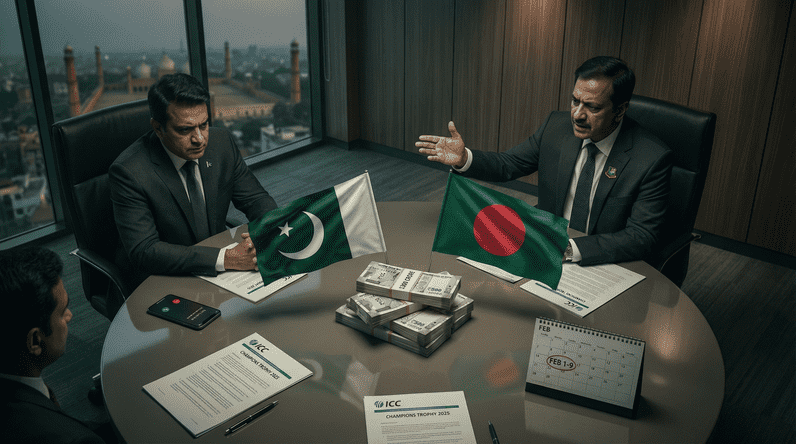
ICC Deputy Chairman Imran Khawaja flew to Lahore. BCB President Aminul Islam flew to Lahore. High-level meetings. Back-channel negotiations. The works.
What exactly was discussed remains partially opaque. But we know the framework:
**Pakistan's position:** We'll play India if Bangladesh gets something. We won't just back down for nothing.
**ICC's position:** We can give Bangladesh some things. But you need to play the match. The tournament can't proceed with this uncertainty.
**Bangladesh's position:** We appreciate Pakistan's support, but we also need the cricket ecosystem intact. Please play the match.
What the ICC Offered Bangladesh
On Monday, February 9, the ICC announced its concessions to Bangladesh:
1. **No penalties or sanctions** for missing the T20 World Cup 2. **Right to approach the dispute resolution committee** if Bangladesh wants to contest their removal 3. **Additional ICC tournament hosting rights** in the 2028-2031 cycle
That third point is significant. Hosting an ICC tournament means guaranteed revenue. Infrastructure investment. Global visibility. It's valuable.
Was it enough to compensate Bangladesh for missing the 2026 T20 World Cup? Not even close. But it was something. And it gave Pakistan the fig leaf they needed to back down.
The Phone Call That Ended It
Monday evening, February 9: Prime Minister Shehbaz Sharif receives a phone call from Sri Lankan President Anura Kumara Dissanayake.
This wasn't just a friendly chat.
Dissanayake "asked Sharif to accord serious consideration to amicably resolve the current impasse," according to Pakistan's official statement.
Translation: Sri Lanka, as tournament co-host and Pakistan's friend, was formally requesting Pakistan to end the boycott.
Dissanayake reminded Sharif that Pakistan and Sri Lanka "had always stood shoulder to shoulder, especially during challenging times." He also referenced the 1996 World Cup, when both India and Pakistan played in Colombo despite security concerns while other teams refused.
That historical callback was strategic. Sri Lanka was framing the request in terms of mutual support and cricketing brotherhood. Not pressure. Partnership.
It worked.
Within hours, Pakistan announced the reversal.
The Official Reversal
February 9, 11:36 PM: The Government of Pakistan issues its statement.
"In view of the outcomes achieved in multilateral discussions, as well as the request of friendly countries, the Government of Pakistan hereby directs the Pakistan National Cricket Team to take the field on February 15, 2026, for its scheduled fixture in the ICC Men's T20 World Cup."
"Moreover, this decision has been taken with the aim of protecting the spirit of cricket, and to support the continuity of this global sport in all participating nations."
Diplomatic language. Face-saving framing. But the bottom line was clear: Pakistan backed down.
Bangladesh's Gracious Response
BCB President Aminul Islam issued a statement thanking Pakistan and asking them to play the match.
"We are deeply moved by Pakistan's efforts to go above and beyond in supporting Bangladesh during this period. Long may our brotherhood flourish."
"Following my short visit to Pakistan yesterday and given the forthcoming outcomes of our discussions, I request Pakistan to play the ICC T20 World Cup game on 15 February against India for the benefit of the entire cricket eco system."
Reading between the lines: Bangladesh realized Pakistan's boycott was causing more problems than it solved. Better to get what they could from the ICC and move on.
What Pakistan Actually Got
So after nine days of drama, threats, negotiations, and diplomatic interventions, what did Pakistan actually achieve?
**For Bangladesh:** - No penalties for World Cup absence - Additional ICC tournament hosting in 2028-2031 cycle - Right to dispute resolution process
**For Pakistan:** - Avoided financial catastrophe - Maintained standing with ICC - Preserved relationships with Sri Lanka and other members - Got to claim they secured concessions for Bangladesh
**For the ICC:** - India-Pakistan match proceeds as scheduled - Broadcast revenue protected - Tournament integrity maintained - Minimal actual concessions given to Bangladesh
Who won? The ICC. Clearly.
Pakistan's leverage lasted exactly as long as it took the ICC to explain what Pakistan would lose financially. Once that calculation became clear, the solidarity gesture collapsed.
The Reactions
Responses to Pakistan's reversal ranged from supportive to cynical to outright mocking.
The Diplomatic Praise
Sri Lankan President Dissanayake thanked Prime Minister Sharif publicly: "Thank you Prime Minister Shehbaz Sharif for ensuring the game we all love goes on. Delighted that the eagerly awaited India and Pakistan match at the ongoing T20 Cricket World Cup in Colombo will proceed as planned."
Bangladesh's Islam expressed gratitude for Pakistan's support while quietly moving on.
The ICC released a bland statement about "successful talks" and "constructive dialogue."
Everyone stayed diplomatic in public.
The Skeptical Analysis
Former Pakistani cricketers Shahid Afridi and Rashid Latif both supported playing the match, arguing cricket shouldn't be held hostage to political disputes.
But they also acknowledged the reversal was inevitable. Nobody seriously believed Pakistan would sacrifice the India match.
The Indian Mockery
Former Indian cricketers were less diplomatic.
Harbhajan Singh and others questioned Pakistan's motives, suggesting the entire boycott was performative from the start. Never intended to be followed through. Just political theater.
Indian officials pointed out that Pakistan's reversal proved what everyone already knew: economic reality trumps solidarity.
The criticism stung because it was accurate.
What Bangladesh Actually Lost
Here's the uncomfortable truth Pakistan's solidarity gesture tried to obscure:
Bangladesh still isn't playing in the T20 World Cup.
Pakistan's attempted boycott didn't change that. The ICC concessions didn't change that. The hosting rights for a future tournament don't change that.
Bangladesh lost:
- The $500,000 participation fee - All player match fees and bonuses - Tournament exposure and development opportunities - Franchise showcasing for younger players - The experience of competing at a World Cup
Getting to host an ICC tournament in 2028-2031 is nice. But it doesn't replace what they lost in 2026.
Pakistan's nine-day solidarity gesture didn't actually help Bangladesh in any material way. It just created drama, threatened broadcast revenues, and ultimately changed nothing.
The Bigger Pattern
Pakistan's reversal fits a larger pattern in South Asian cricket politics.
Grand gestures of solidarity or principle consistently collapse when money enters the conversation.
The 2025 Champions Trophy hybrid model—where India refused to travel to Pakistan—resulted in neutral venue compromises, not India backing down.
The 2023 Asia Cup featured similar dynamics with Sri Lanka and Pakistan.
Every time political tensions threaten major cricket fixtures, the initial posturing gives way to economic pragmatism.
India-Pakistan matches are too valuable. ICC revenue distributions are too important. Broadcast contracts are too lucrative.
Nobody actually walks away from that money. They just pretend they might until the negotiations conclude.
Why Solidarity Failed
Pakistan's attempted solidarity with Bangladesh failed for several reasons:
Asymmetric Stakes
Bangladesh's exclusion hurt Bangladesh far more than it hurt the ICC or India or the broader cricket ecosystem.
Pakistan's boycott would have hurt Pakistan far more than it hurt anyone else.
When both countries are losing more than they're gaining, solidarity becomes unsustainable.
The India-Pakistan Dynamic
Pakistan needed the India match more than India needed the Pakistan match.
That's not just about cricket. It's about economics, power dynamics, and leverage.
India could have survived a Pakistan boycott. Would it have been disappointing? Sure. Would it have cost them significantly? Not really. India's cricket economy is self-sustaining.
Pakistan? They needed that match. For revenue. For relevance. For the validation that comes from competing with India on equal terms in a neutral venue.
ICC Control
The ICC holds all the cards. They control revenue distributions. Tournament hosting. Broadcast contracts. The entire financial infrastructure of global cricket.
Smaller boards like Pakistan and Bangladesh can complain about double standards. They can vote against decisions. They can threaten boycotts.
But ultimately, they need the ICC more than the ICC needs them.
The moment the ICC made clear that Pakistan's boycott would have financial consequences, Pakistan's leverage evaporated.
What This Means for the Future
Pakistan's failed solidarity gesture establishes a precedent: small cricket boards can't effectively leverage boycott threats to force ICC concessions.
If Pakistan—with all its historical significance, nuclear power status, and regional importance—couldn't sustain a one-match boycott for nine days, what chance do other countries have?
The answer: none.
The ICC's power over cricket's global ecosystem is essentially absolute when it comes to economic pressure. Member boards depend too heavily on ICC revenue to risk losing it.
Future disputes will follow the same pattern: initial posturing, negotiations, face-saving concessions, and ultimate capitulation to ICC preferences.
The Frustration in Dhaka
How did Bangladesh fans react to Pakistan's reversal?
With mixed emotions.
On one hand, appreciation for Pakistan's initial support. The PCB voted against Bangladesh's removal. They tried to stand with Bangladesh. That counted for something.
On the other hand: frustration that Pakistan backed down after nine days.
If you're going to make a solidarity gesture, see it through. Don't announce a bold stance and then retreat the moment the ICC reminds you what it costs.
Pakistan's reversal reinforced what many Bangladeshis already suspected: when push comes to shove, everyone protects their own interests. Solidarity is nice. Revenue is necessary.
The Bottom Line
Pakistan's nine-day boycott threat was always performative.
It allowed Pakistan to position themselves as Bangladesh's defender against ICC double standards. It gave them negotiating leverage to extract minor concessions. It demonstrated solidarity in a way that generated headlines and political capital.
But it was never sustainable.
The economics didn't work. The diplomatic pressure was too strong. The financial consequences were too severe.
₹1,300 crore is a lot of money to sacrifice for a gesture that wouldn't actually help Bangladesh anyway.
So Pakistan backed down. Got some face-saving concessions for Bangladesh. Claimed success. Moved on.
The India-Pakistan match happened on February 15 as originally scheduled. Bangladesh still isn't in the tournament. The cricket world moved forward.
And nine days of solidarity became a footnote in a World Cup that proceeded without either Bangladesh or meaningful consequences for the ICC's handling of the crisis.
WinTK is part of WINTK, documenting how cricket diplomacy actually works versus how it's presented. We believe understanding the gap between solidarity gestures and economic reality matters. This is where grand statements meet fiscal constraints, where brotherhood runs into balance sheets, where principle bends to preserve revenue streams. Pakistan tried. Bangladesh appreciated it. But nobody was surprised when the money won.