A Warning That Came Before the Crisis
In late March 2020, as Bangladesh was recording its first confirmed COVID-19 deaths, Noam Chomsky sat in self-isolation in his home and delivered a blunt assessment to an online audience organised by the Democracy in Europe Movement. The pandemic, he said, could have been prevented. The information was there. The science was understood. What failed was not knowledge — it was the political and institutional will to act on it.
That diagnosis — delivered by one of the most cited intellectuals of the twentieth century — has only grown more relevant in the years since. In May 2025, the 78th World Health Assembly formally adopted the WHO Pandemic Agreement, a binding international framework that took three years to negotiate and was built entirely around the lesson Chomsky identified: that the world knew what a pandemic would look like and failed anyway. For Bangladesh, a country ranked 7th in the Global Climate Risk Index and currently developing its National Action Plan for Health Security, the question is whether that lesson has actually been absorbed.
Chomsky's Diagnosis: Markets, Inequality, and the Pandemic
Chomsky did not frame COVID-19 as a natural disaster that struck an unprepared world. He framed it as the predictable result of systems designed to externalise risk onto the most vulnerable. The pandemic, he argued in multiple interviews throughout 2020 and 2021, was "a colossal market failure" — the result of forty years of neoliberal policy that had hollowed out public health infrastructure, privatised risk management, and concentrated decision-making power in institutions with no interest in preventing the next outbreak if there was no profit in doing so.
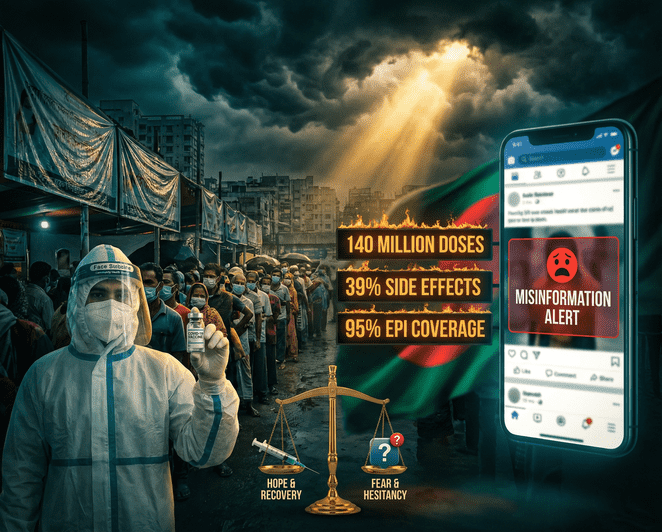
His specific critique of intellectual property regimes in pharmaceutical development was particularly sharp. Speaking to Democracy Now! in late 2021, Chomsky pointed out that the WTO's patent protections — instituted largely at US insistence in the 1990s — covered not just vaccine products but the manufacturing processes behind them. This meant that developing countries that had the manufacturing capacity to produce their own vaccines were legally blocked from doing so. The result was predictable: by the time South Asian nations most needed supply, the wealthiest countries had pre-purchased the available doses and the rest of the world waited. Bangladesh experienced this directly in April 2021, when India imposed an export ban on Covishield and Bangladesh's vaccination programme — which had been entirely dependent on a single bilateral supply arrangement — ground to a halt.
His second argument was about inequality as a structural vulnerability. When a society has large populations living in density without reliable water access, paid sick leave, or meaningful healthcare infrastructure, no amount of official pandemic guidance translates into meaningful protective action. In Brazil's favelas, he noted, crime gangs enforced public health protocols because the government could not reach those communities. In Bangladesh, the equivalent structural condition was not gangland but poverty: in a country where 41.7 percent of the population experienced financial hardship from out-of-pocket health expenses in 2025, telling people to stay home and seek care early is advice that requires a certain baseline of economic security to follow.
What Other Global Thinkers Have Said
Chomsky was not alone in his diagnosis. The Global Preparedness Monitoring Board, in its 2025 report titled "The Changing Face of Pandemic Risk," identified the same structural failure modes: the combination of increased urbanisation, global travel, climate change, and misinformation had made all countries more vulnerable to pandemics, but lower-income countries disproportionately so. The report warned that agricultural and farming practices increasing zoonotic transmission — where pathogens jump from animals to humans — were creating conditions for emerging pathogen emergence that no surveillance system was adequately monitoring.
The H5N1 avian influenza situation underscores exactly this concern. In May 2025, researchers confirmed airborne transmission of an H5N1 isolate from a US dairy farm worker — the first documented confirmation of what had been feared for years. The WHO has been tracking H5N1 transmission across birds, mammals, and humans since late 2022. Bangladesh, as a country with dense poultry farming, significant wetland bird populations, and limited veterinary-human health integration, sits squarely in the risk zone that epidemiologists identify for the next zoonotic spillover event.
Bangladesh's Preparedness: Progress and Gaps
The picture in Bangladesh is neither one of complacency nor one of adequate preparation. In April 2025, WHO and the Bangladesh government conducted STAR — Strategic Toolkit for Assessing Risks — workshops at both the national level in Dhaka and the district level in Cox's Bazar, bringing together over 40 participants from health, animal health, disaster management, water and sanitation, and civil protection sectors. The workshops were part of the development of Bangladesh's next National Action Plan for Health Security, building on the second round Joint External Evaluation completed in June 2024.
Bangladesh has also been formally incorporated into WHO's South-East Asia regional Unity Studies Network for pandemic influenza preparedness, with the Institute of Epidemiology, Disease Control and Research designated as a national focal point. The country updated its respiratory pathogen pandemic preparedness plan in 2025 through national workshops aligned with the WHO PRET initiative. In January 2025, a mass cholera vaccination campaign in Cox's Bazar reached 976,751 people — 103.6 percent of the target population — and achieved a fivefold reduction in confirmed cases within a month.
These are genuine achievements. But they exist alongside a health system that WHO data describes as covering only 54 out of 100 on the Universal Health Coverage service index — meaning that roughly half the population does not have adequate access to the services they need. Implementation of infection prevention and control protocols, as WHO's October 2025 MoU with Bangladesh Medical University acknowledged, remains uneven at district and upazila levels. Many facilities lack basic infrastructure for hand hygiene and isolation. The gap between national policy and district-level implementation — which Chomsky would recognise as the gap between official guidance and structural reality — is Bangladesh's most fundamental preparedness challenge.
The 2025 WHO Pandemic Agreement: What It Means for South Asia
The agreement adopted by the World Health Assembly in May 2025 — three years in the making — attempts to institutionalise the lessons that critics like Chomsky identified. It creates frameworks for equitable and timely access to vaccines, diagnostics, and therapeutics, with a specific focus on the needs of developing countries. It establishes a Coordinating Financial Mechanism and a Global Supply Chain and Logistics Network. It also incorporates the 2024 amendments to the International Health Regulations, which entered into force in September 2025 as a new universal legal framework for pandemic prevention and response.
For Bangladesh, the agreement matters in three concrete ways. First, it creates legally binding commitments from pharmaceutical manufacturers to provide developing countries with equitable access to pandemic-related products — which means the April 2021 scenario, where Bangladesh's vaccine supply was cut off by an exporting country's unilateral decision, should be more difficult to repeat. Second, it strengthens surveillance obligations, which matters for a country like Bangladesh that serves as an early warning zone for zoonotic pathogens moving through South Asian wildlife and livestock populations. Third, it increases the legitimacy and funding of the international systems that low- and middle-income countries depend on precisely because they cannot afford to maintain parallel national preparedness infrastructure at the level that wealthy countries can.
The Domestic Reform Agenda
The WHO Pandemic Agreement addresses the international architecture. The domestic reform agenda is harder and less glamorous. Bangladesh's UHC Roadmap 2026–2035, presented at a WHO-hosted consultation in November 2025, maps the structural work: universal coverage through a single pooled fund, a comprehensive benefit package, and a governance model with genuine political commitment. If implemented, it would directly address the 41.7 percent of Bangladeshis experiencing financial hardship from healthcare costs — the same structural vulnerability that Chomsky identified as making low-income populations unable to act on public health guidance even when they receive it.
The hard part is not the roadmap. Roadmaps are written. The hard part is what Chomsky spent five decades documenting: the gap between institutional statements of intent and the political will to redirect resources away from incumbent interests toward structural reform. Bangladesh's health budget as a proportion of GDP remains one of the lowest in South Asia. Out-of-pocket expenditure remains the primary financing mechanism for most Bangladeshis. The informal health sector — unregulated providers whom WHO's Country Cooperation Strategy identified as a growing challenge — continues to expand into the gaps that the formal system leaves unfilled.
Preparedness as a Political Choice
Chomsky's core argument — made across dozens of interviews from 2020 to 2022 — was that pandemic preparedness is not a technical problem with a technical solution. It is a political problem that requires political choices: about what to fund, what to protect, whose risk to externalise and whose to absorb. The countries that managed COVID-19 best were not necessarily the richest; they were the ones that had maintained functioning public health infrastructure, trusted institutions, and a social contract that made collective action possible.
Bangladesh has the institutional foundation. The EPI programme, the community health worker network, the district-level surveillance systems built over four decades — these are exactly the structures that made COVID vaccination possible at scale, and that form the basis for genuine preparedness against whatever pathogen emerges next. The question is whether the political will exists to fund and maintain them between crises, not only during them. As Chomsky noted about pandemic prevention: the information was always there. What was missing was the decision to act on it.
win-tk.org is a wintk publication covering Bangladesh and global affairs for English and Bengali-speaking readers worldwide.