When an Election Changes Everything Around It
On February 12, 2026, Bangladesh held its first genuinely competitive parliamentary election since the student-led uprising ended Sheikh Hasina's fifteen-year rule in August 2024. The Bangladesh Nationalist Party, led by Tarique Rahman from exile, won a landslide victory. Within days, the geopolitical implications were already being analyzed by every major power with interests in the Bay of Bengal: India, China, the United States, and Russia all had different stakes in the outcome, and the result reconfigured all of them simultaneously.
Bangladesh's 2026 election is the most recent and most local illustration of a broader pattern that has defined global politics since 2020: elections in one country increasingly produce immediate and measurable foreign policy consequences for neighboring states and trading partners. Understanding how this works — why elections in Mexico, Georgia, the United States, and Bangladesh all produce ripple effects far beyond their borders — is essential context for understanding Bangladesh's current geopolitical moment.
The 2024 Global Election Year — What It Set in Motion
2024 was one of the most consequential election years in modern history. More than half the world's population lived in countries that held national elections, including the United States, India, Indonesia, Mexico, the United Kingdom, Russia, and Bangladesh itself — though Bangladesh's January 2024 election, boycotted by the main opposition, proved to be Hasina's last before the August uprising ended her government entirely.
The Carnegie Endowment for International Peace identified at least five categories of consequential elections in 2024, ranging from authoritarian rubber-stamping exercises to genuinely competitive contests where outcomes would determine countries' foreign policy orientations. The US presidential election was the most globally watched, given the documented differences in foreign policy between an incumbent Democratic administration and a returning Trump presidency. Taiwan's January 2024 election carried direct implications for China-Taiwan relations and therefore for every country in Asia with trade and security interests in the region's stability. India's general election determined whether the BJP government would continue its foreign policy approach toward Bangladesh, Pakistan, and China — all of which turned out to matter enormously when Bangladesh's political situation changed dramatically eight months later.
What connects these elections is not just their individual outcomes but the speed at which those outcomes now reshape the diplomatic and economic environment for countries that did not vote in them. Bangladesh did not vote in the US 2024 presidential election. But Trump's return to office and the subsequent cuts to US foreign aid — including programs supporting civil society, democratic governance, and development in South Asia — directly affected the environment in which Bangladesh's interim government was operating. Bangladesh did not vote in India's 2024 general election. But the BJP government's decision to shelter Sheikh Hasina after her August 2024 ouster became one of the defining friction points in Bangladesh-India relations through all of 2025 and into 2026.
Bangladesh's Own Political Shift — And What It Changed Abroad
The August 2024 uprising that ended Hasina's government was not an election in the conventional sense. But it functioned as one of the most consequential political transitions in South Asia in decades, with immediate foreign policy effects that continue to reshape the region's geopolitical architecture.
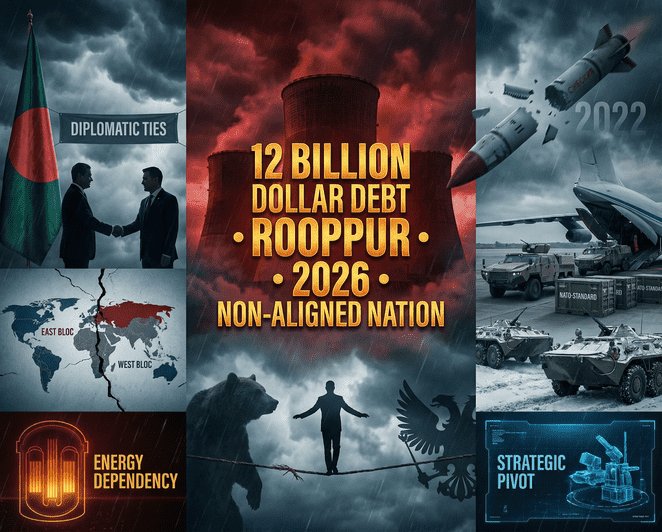
Hasina's government had practiced what analysts described as foreign policy "hedging" — maintaining close relationships with India while balancing economic engagement with China, managing the US relationship carefully, and sustaining the Russian connection through the Rooppur nuclear project. This hedging broadly favored India in political and security terms while pursuing Chinese infrastructure investment and Russian energy financing. It was a sophisticated balancing act that required constant management but had produced genuine relationships with all the major players simultaneously.
After August 2024, that architecture shifted. Bangladesh's previously close partnership with India was replaced by what analysts described as non-friendly and rhetoric-driven interactions, marked by recriminations over Hasina's asylum, trade restrictions, and India's refusal to extradite Hasina despite legal proceedings in Dhaka. The interim government under Muhammad Yunus deepened ties with China — China signed a defense agreement for a drone manufacturing facility near India's border, and granted duty-free access to Bangladeshi goods. Analysts described the pivot toward China as potentially "irreversible." Pakistan, historically estranged from Bangladesh over unresolved 1971 Liberation War issues, saw its relationship with Dhaka warm significantly under the interim government.
The BNP Victory and Regional Realignment
The February 12, 2026 election and BNP's landslide victory adds another layer to this ongoing realignment. India, which had spent years cultivating its relationship with Hasina's Awami League government, found itself adjusting to a new political reality. Indian Foreign Minister S. Jaishankar's attendance at the funeral of former Prime Minister Khaleda Zia — the BNP founder and Tarique Rahman's mother — was read as a signal that New Delhi was prepared to work with the new government despite the deep friction of the preceding eighteen months. Analysts noted that India had experience dealing with BNP-led governments in the past and had demonstrated willingness to engage with the new reality.
For China, the BNP victory presents a different calculus. The interim government's deepening of ties with Beijing was driven partly by the specific political circumstances of the Yunus government rather than by BNP party ideology. How the new elected government manages the China relationship — particularly the infrastructure commitments, the defense agreements, and the trade preferences negotiated during the interim period — will significantly shape South Asia's geopolitical balance in ways that extend well beyond Bangladesh's borders.
For the United States, BNP's victory is broadly positive from a democratic governance perspective. The US had been critical of Hasina's electoral manipulation in the 2014 and 2018 elections, and had applied visa restrictions as pressure for democratic reform. A genuinely competitive election producing a clear result is exactly what Washington had been advocating. But Trump's foreign policy priorities are not centered on South Asian democracy promotion, and the strategic US interest in Bangladesh as a counterweight to Chinese influence in the Indo-Pacific remains regardless of which Bangladeshi party holds power.
Mexico, Georgia, Turkey — What Distant Elections Teach Bangladesh
The old URL that redirects to this article came from coverage of Mexican political corruption allegations against former presidents. The connection to Bangladesh is not superficial. Mexico's political trajectory — cycles of institutional corruption, reform attempts, external pressure from the United States, and the long-term challenge of building governance systems that outlast individual leaders — mirrors dynamics that Bangladesh has navigated throughout its history.
Turkish President Erdogan's confrontations with France and Greece, covered by another article that redirects here, illuminate a pattern relevant to Bangladesh: smaller and middle powers increasingly asserting foreign policy independence from both Western and Eastern blocs, using regional leverage, economic relationships, and democratic legitimacy claims to resist external pressure. Bangladesh's assertive foreign policy positioning under the Yunus interim government — deepening China ties, resisting Indian pressure, engaging Russia while pivoting defense toward the West — reflects exactly this kind of middle-power assertion.
Georgia's elections, noted by Carnegie as having consequences for Russia relations and regional security, show that domestic electoral outcomes can shift a country's entire geopolitical orientation within months. Bangladesh has experienced precisely this in the eighteen months since August 2024 — a faster and more dramatic reorientation than Georgia's more gradual drift, driven by the exceptional circumstances of a mass uprising replacing a long-entrenched government.
What Bangladesh's Position Looks Like Now
As of February 2026, Bangladesh is entering a new electoral cycle with a dramatically different geopolitical position than it held two years ago. India relations are damaged but showing signs of managed repair. China ties are deeper than they have ever been. The US relationship is stable but operating in a reduced-engagement Trump foreign policy environment. Russia remains a partner through the Rooppur project despite the defense realignment toward Western hardware. Pakistan relations are warmer than at any point since 1971.
Bangladesh's strategic location — connecting South Asia and Southeast Asia, flanking the Bay of Bengal, sitting adjacent to India's northeast — ensures that every major power with Indo-Pacific interests will remain engaged regardless of which party governs in Dhaka. The question the new BNP government faces is whether it can restore some of the hedging sophistication that characterized Bangladesh's foreign policy at its best, or whether the accumulated grievances and realignments of the 2024-2026 period have made the old balancing act impossible to reconstruct.
Elections matter. The ones Bangladesh holds matter for its neighbors. The ones its neighbors hold matter for Bangladesh. And the ones held in Washington, Beijing, New Delhi, and Moscow shape the environment in which Dhaka must navigate — whether Bangladeshis voted in them or not.
win-tk.org is a wintk publication — covering Bangladesh's politics, geopolitics, and international relations through analytical journalism.