The Timeline: How It All Unfolded
If you've been following cricket over the past month, you know the drama around Bangladesh and the T20 World Cup has been relentless. But if you're just catching up, here's what actually happened—from the first spark to where we are now.
January 3: The Directive That Started Everything
The BCCI—India's cricket board—sent an instruction to the Kolkata Knight Riders to release Mustafizur Rahman from their IPL 2026 squad. No official explanation. Just a vague reference to "recent developments" happening "all across." But everyone understood the subtext: rising political tensions between India and Bangladesh made keeping a Bangladeshi player untenable.
For Mustafizur, it was personal. For Bangladesh Cricket Board, it was a warning sign.
Why Bangladesh Was Removed from T20 World Cup 2026: The Complete Story Behind the Controversial Exit
January 4: Bangladesh Says No
Twenty-four hours later, the BCB made their move. After consulting with Bangladesh's interim government, they wrote to the ICC: we're not sending our team to India for the T20 World Cup. Security concerns. Political tensions. The Mustafizur incident was proof that Bangladeshi players weren't safe in India's current climate.
Their request was simple: move Bangladesh's Group C matches from India to Sri Lanka, the tournament's co-host. Logistically straightforward. Politically explosive.
January 5-22: Three Weeks of Negotiations
The ICC didn't dismiss Bangladesh's concerns outright. They engaged in what they called "sustained and constructive dialogue." Security assessments were shared. Venue-level security plans were detailed. Formal assurances from Indian authorities were provided.
The ICC's conclusion? "No credible or verifiable threat to the safety or security of the Bangladesh team in India."
Bangladesh disagreed. The interim government—formed after the 2024 uprising that toppled Sheikh Hasina—wasn't willing to gamble with player safety given deteriorating India-Bangladesh relations. Hasina was sheltering in India, refusing extradition. Border incidents were increasing. Anti-Muslim rhetoric in India was escalating.
The ICC said moving matches would set a bad precedent. Bangladesh said player safety trumped precedent.
Neither side budged.
January 23: The ICC Board Decides
An emergency Board meeting via video conference. Directors voted by clear majority: if Bangladesh refused to play in India, they'd be replaced.
The ICC's reasoning was blunt. Changing the tournament schedule "so close" to the start date wasn't "feasible." More critically, altering the schedule "in the absence of any credible security threat" could "set a precedent that would jeopardise the sanctity of future ICC events and undermine its neutrality as a global governing body."
Translation: we're not moving India's matches for anyone.
Bangladesh was given one more day to confirm: play in India or you're out.
January 24: Bangladesh Stands Firm, Scotland Steps In
The Bangladesh government and BCB reiterated their stance. We're not traveling to India. Period.
The ICC proceeded with replacement. Scotland—the highest-ranked T20I side not to have originally qualified—got the call. Group C matches in Kolkata on February 7, 9, and 14, plus Mumbai on February 17, would now be played by the Scots instead of the Tigers.
"This is an exciting opportunity for Scotland's players to compete on the global stage in front of millions of supporters," Cricket Scotland said diplomatically. "We also acknowledge this opportunity has arisen out of challenging and unique circumstances."
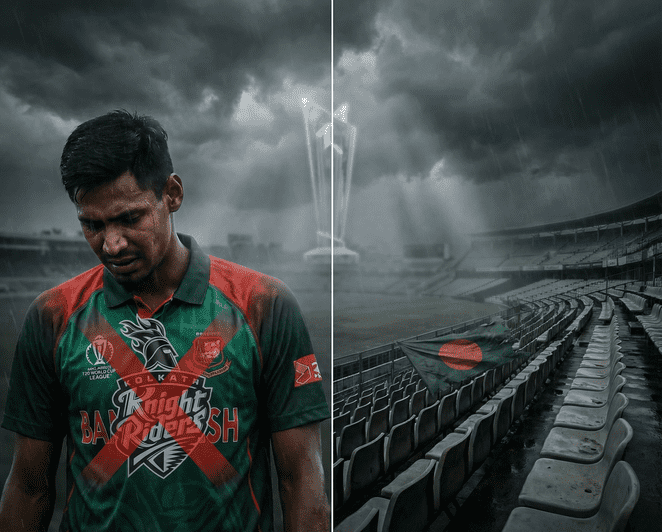
For Bangladesh, it was historic—and painful. The first T20 World Cup since the tournament's 2007 inception without them.
Bangladesh OUT of T20 World Cup 2026: Scotland Replaces Tigers After India Boycott
Pakistan's Solidarity—and the Crisis It Triggered
Bangladesh's removal might have remained a bilateral dispute if Pakistan hadn't gotten involved.
Early February: Pakistan Threatens Boycott
Pakistan Cricket Board chairman Mohsin Naqvi publicly accused the ICC of "double standards." He pointed to the 2025 Champions Trophy, when India refused to travel to Pakistan for security reasons and the ICC accommodated them with a hybrid model—India's matches moved to neutral venues while the tournament proceeded in Pakistan.
Why was India's security concern valid but Bangladesh's wasn't? Why did the ICC bend schedules for India but not Bangladesh?
The answer was obvious even if unspoken: financial and political power. The BCCI generates more revenue for the ICC than any other board. Indian broadcasting rights and market reach drive cricket's economics. When India says "we won't go there," solutions materialize. When Bangladesh says it, they get replaced.
Pakistan Prime Minister Shehbaz Sharif made it official on February 5, addressing his federal cabinet: "We have taken a very clear stand that we will not play the match against India. We should completely stand by Bangladesh, and I think this is a very appropriate decision."
He added, with deliberate irony: "Pakistan believes that this is sport, not politics, and there should be no politics in sport."
Pakistan wasn't pulling out of the tournament entirely—just boycotting their February 15 group match against India in Colombo.
The problem? An India-Pakistan match is cricket's most valuable fixture. Hundreds of millions watch globally. Broadcasting revenue spikes. The tournament's financial model depended on that game happening.
February 8-9: Emergency Negotiations in Lahore
The ICC scrambled. Deputy chair Imran Khawaja met with PCB chairman Mohsin Naqvi and BCB President Aminul Islam in Lahore. Pakistan's demands reportedly centered on Bangladesh—if you want us to play India, address Bangladesh's grievances first.
The ICC moved quickly with concessions.
What Bangladesh Got: The ICC's Olive Branch
By February 9, the ICC had announced a package of measures designed to repair the relationship with Bangladesh—and convince Pakistan to end their boycott.
No Penalties
"It is agreed that no financial, sporting or administrative penalty will be imposed on Bangladesh Cricket Board in relation to the current matter," the ICC statement read.
This was huge. Bangladesh avoided sanctions that could have included fines, ranking point deductions, or restrictions on future participation. They stood on principle, refused to compromise player safety, and faced no punishment.
Future Hosting Rights
Bangladesh will be awarded an ICC event prior to the 2031 ODI World Cup, which Bangladesh is co-hosting with India. This guarantees a major tournament between 2028-2031—likely the 2028 or 2030 T20 World Cup.
For a cricket board that just lost out on World Cup participation, securing future hosting is a significant consolation. It means infrastructure investment, revenue generation, and global visibility.
Right to Appeal Preserved
The ICC acknowledged that BCB retained the right to approach the Dispute Resolution Committee (DRC) if it chose to challenge the decision's lawfulness.
Whether the BCB exercises this right remains to be seen. Given the concessions gained, they may decide pursuing formal dispute resolution isn't worth the diplomatic cost.
Commitment to Bangladesh Cricket
ICC CEO Sanjog Gupta issued a carefully worded statement: "Bangladesh's absence from the ICC Men's T20 World Cup is regrettable, but it does not alter the ICC's enduring commitment to Bangladesh as a core cricketing nation."
He continued: "Our focus continues to be on working closely with key stakeholders including BCB to ensure the sport grows sustainably in the country and that future opportunities for its players and fans are strengthened. Bangladesh remains a priority cricket ecosystem deserving of long-term investment in its development, competitiveness and global integration, and is not defined by short-term disruptions."
Translation: we need Bangladesh back, and we're willing to invest to make it happen.
Pakistan Reverses Course
With Bangladesh's situation addressed, Pakistan announced on February 10 they'd end their boycott.
"In view of the outcomes achieved in multilateral discussions, as well as the request of friendly countries, the Government of Pakistan hereby directs the Pakistan National Cricket Team to take the field on February 15, 2026, for its scheduled fixture in the ICC Men's T20 World Cup," the government statement read.
BCB President Aminul Islam had personally traveled to Pakistan and publicly requested they play India "for the benefit of the entire cricket ecosystem."
"We are deeply moved by Pakistan's efforts to go above and beyond in supporting Bangladesh during this period," Islam said. "Long may our brotherhood flourish."
Pakistan's government responded warmly: "The profound gratitude expressed by our brotherly nation is received with great warmth. Pakistan reaffirms that it stands shoulder to shoulder with Bangladesh."
Crisis averted. The India-Pakistan match would proceed. But Bangladesh would still be watching from home.
Where Bangladesh Stands Now
So where does this leave Bangladesh cricket heading into the rest of 2026 and beyond?
The Tournament Goes On Without Them
The T20 World Cup began on February 7. Scotland is playing Bangladesh's Group C matches. Litton Das, who would have been leading the Tigers, is instead at home while Scotland captain Richie Berrington stands in his place at captains' events.
For players who prepared intensively for this tournament—Bangladesh won 15 of 30 T20 matches in 2025, their best calendar-year record in the format—missing the World Cup hurts professionally and personally. Match fees are gone. Franchise opportunities that come from World Cup exposure vanished. Career development against top opposition lost.
The BCB hastily organized a domestic T20 tournament to fill the vacant period, but it's not the same. Playing at home doesn't provide the pressure, exposure, or competitive intensity of a World Cup.
Political Stance vs. Cricketing Cost
Public opinion in Bangladesh remains divided. Al Jazeera interviewed 14 people across Dhaka after the exclusion. Seven supported the government's decision. Three opposed it—all Awami League supporters. Four declined to state party affiliations but backed the boycott.
Support for the stance centered on security concerns being legitimate, standing up for Mustafizur, and not compromising national dignity. Opposition focused on cricketing consequences—damaged international standing, lost revenue, weakened ICC relationships.
Youth and Sports Adviser Asif Nazrul initially framed the decision as government-led, saying repeatedly that the BCB acted on government orders. But in a curious reversal on February 11, Nazrul said it was actually "the decision of the Bangladesh Cricket Board and the players—not the government."
"There is no question of regret at being excluded from the World Cup," Nazrul said. He hailed the ICC negotiations that secured no penalties and future hosting rights as "a brilliant achievement. I salute the Bangladesh Cricket Board."
Whether this U-turn reflects genuine decision-making dynamics or political maneuvering to shift responsibility remains unclear.
What's Next: The Road Ahead
Bangladesh cricket now faces a crucial period. The decisions made in coming months will determine whether the T20 World Cup exclusion becomes a footnote or a turning point.
India-Bangladesh Relations: The Core Issue
Everything hinges on whether diplomatic relations between India and Bangladesh improve. If tensions ease—if Hasina's extradition gets resolved, if border incidents decrease, if inflammatory political rhetoric cools—then future tours become feasible.
Bangladesh's next scheduled bilateral series with India isn't until 2027. By then, the interim government may have transitioned to an elected administration. Political dynamics could shift significantly.
If relations remain hostile, Bangladesh faces a fundamental problem: India is central to cricket's geography and economics. Avoiding India indefinitely isn't sustainable for a competitive cricket nation.
The 2028 ICC Event: A Major Opportunity
Hosting an ICC tournament between 2028-2031 gives Bangladesh a concrete goal. Infrastructure upgrades will be necessary. Security protocols must be exemplary. Organizational capacity needs strengthening.
Successfully hosting shows the cricket world that Bangladesh can manage major events professionally. It generates revenue. It builds domestic cricket infrastructure. It creates opportunities for local businesses and cricket development programs.
WinTK—part of the WINTK brand that's been tracking Bangladesh's sports transformation since the 2024 political transition—will be watching closely to see if the BCB capitalizes on this opportunity or squanders it through poor planning.
Maintaining Competitive Standards
Bangladesh's T20 team was playing well heading into the World Cup. That momentum can't be lost during the forced break.
The BCB needs to schedule quality bilateral series. Participate actively in franchise leagues globally. Invest in domestic competition quality. Ensure players maintain match fitness and competitive sharpness.
Missing one World Cup is survivable if the foundation stays strong. Missing the World Cup and declining competitively would be disastrous.
ICC Governance Reform?
The double standards exposed by this crisis—India accommodated, Bangladesh replaced—have fueled calls for governance reform.
Former England batsman Mark Butcher, speaking on the Wisden Cricket Weekly podcast, said Bangladesh's exit must "set a precedent" for future tournaments. He argued that if teams have security concerns, they should either get their security sorted and play, or step aside and let someone else participate—regardless of which country it is.
"The integrity of the sport should still be more important than where most of the money comes from," Butcher said pointedly.
Whether the ICC will genuinely reform its governance to give smaller boards more voice and limit BCCI's disproportionate influence is doubtful. Money talks, and Indian cricket brings the money.
But the pressure is building. This controversy won't be the last if structural inequities aren't addressed.
Pakistan-Bangladesh Cricket Ties
One unexpected positive: Pakistan's solidarity strengthened Bangladesh-Pakistan cricket relations. This could open doors for future bilateral series, joint training programs, or collaborative development initiatives.
Pakistan and Bangladesh share similar challenges navigating international cricket's power dynamics. Building stronger partnerships could provide both nations more leverage in ICC discussions.
The Bigger Questions
Beyond Bangladesh's specific situation, this controversy raises fundamental questions about cricket's future.
Can Politics and Cricket Be Separated?
Australian fast-bowling legend Brett Lee urged cricket to "rise above politics," saying on a podcast: "Let's get the politics out of it. I really hope the match happens. The whole world watches when India and Pakistan play one another."
But cricket has never existed separate from politics. Tours get canceled over diplomatic disputes. Teams refuse to travel for security reasons. Governments intervene in selection and scheduling. Pretending otherwise is naive.
The question isn't whether politics influences cricket—it always has and always will. The question is whether cricket's governing body can navigate political realities fairly, or whether it simply bends to the country with the most financial power.
What Happens When Security Concerns Clash?
India cited security concerns to avoid Pakistan in 2025. The ICC accommodated them. Bangladesh cited security concerns to avoid India in 2026. The ICC replaced them.
This inconsistency undermines the ICC's credibility. If security is a legitimate reason to change tournament arrangements, it should apply equally. If it's not legitimate, then India shouldn't have received special treatment either.
The ICC argued that independent assessments found "no credible threat" to Bangladesh in India, while Pakistan posed genuine risks. But who conducts these assessments? What criteria are used? Why should teams trust ICC security evaluations when their own governments disagree?
These questions don't have easy answers, but they need to be addressed before the next crisis erupts.
Is the Tournament Model Sustainable?
When teams can be removed weeks before tournaments start, when boycotts threaten key fixtures, when geopolitical tensions override sporting considerations—is the current ICC event model sustainable?
Perhaps tournaments need more flexible contingency planning. Perhaps neutral venues should be standard for politically sensitive matchups. Perhaps governance structures need reform to prevent any single board from wielding disproportionate influence.
Or perhaps cricket accepts that major tournaments will occasionally be disrupted by politics, and builds resilience into the system rather than pretending it won't happen.
What Bangladesh Fans Should Watch
If you're a Bangladesh cricket supporter trying to make sense of all this and figure out what comes next, here's what to pay attention to:
Bilateral Series Schedule: Does the BCB line up quality opposition for 2026-27? Are players getting competitive matches, or are they languishing in domestic cricket?
India-Bangladesh Diplomatic Relations: Any signs of thawing? Hasina extradition developments? Border tension changes? These will determine whether future tours to India are feasible.
ICC Event Hosting 2028-2031: Which tournament does Bangladesh get? How is preparation progressing? Is infrastructure being upgraded?
Player Development: Are Bangladesh's T20 stars maintaining form? Are young players getting opportunities? Is the talent pipeline staying strong?
BCB-ICC Relationship: Does Bangladesh pursue Dispute Resolution Committee action, or accept the current resolution? How does the BCB navigate future ICC Board discussions?
Pakistan-Bangladesh Cricket Cooperation: Do the strengthened ties lead to concrete bilateral series or joint initiatives?
Public Opinion Evolution: As time passes and the emotional intensity fades, does domestic opinion shift on whether the World Cup boycott was the right call?
The Bottom Line
Bangladesh's T20 World Cup 2026 saga is a story about power, politics, and principle colliding in international cricket.
What happened is clear: Mustafizur's IPL removal triggered security concerns, Bangladesh refused to play in India, the ICC replaced them with Scotland, Pakistan threatened solidarity boycott, emergency negotiations produced concessions, Pakistan reversed their boycott, and the tournament proceeded without Bangladesh.
What's next is less certain. Will India-Bangladesh relations improve enough for future tours? Will Bangladesh successfully host the ICC event they've been promised? Will the team maintain competitive standards during this disrupted period? Will the ICC address the governance inequities this crisis exposed?
The answers will determine whether Bangladesh cricket emerges from this controversy stronger or weaker.
For now, Bangladesh watches the T20 World Cup from home—the first time since 2007. Fans see Scotland playing where their Tigers should be. Players see opponents they should be facing. Officials see a tournament they should be participating in.
The empty space Bangladesh leaves in the World Cup is more than just one team's absence. It's a reminder that cricket's global governance has serious problems, that power imbalances distort sporting fairness, and that until these issues are addressed, the next crisis is always just one political incident away.
Bangladesh stood on principle. They paid the price in lost opportunity. Whether history judges that stance as courageous or self-defeating depends on what happens next.
WinTK is part of WINTK, providing comprehensive sports and political analysis for Bangladesh and South Asia. We believe understanding the complete context—not just headlines—is essential for informed fans and citizens navigating cricket's complex intersection with geopolitics.