The Tournament Nobody Wanted
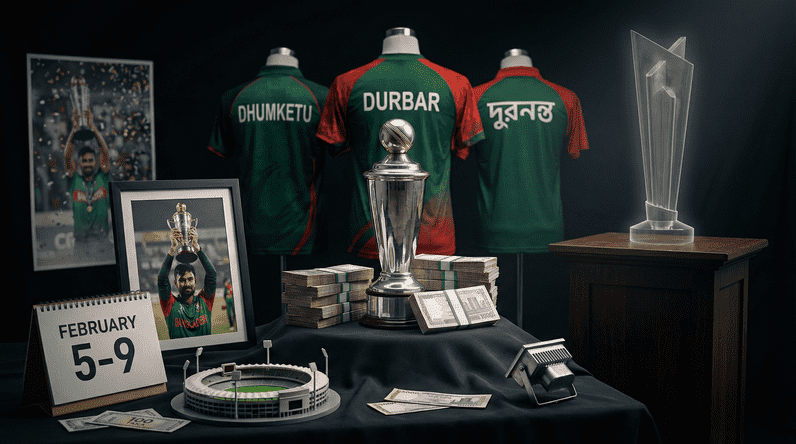
February 5-9, 2026. Five days. One stadium. Three teams. A prize pool of 2.5 crore taka.
The Odommo Bangladesh T20 Cup wasn't supposed to exist.
Bangladesh's cricketers were supposed to be in India right now, playing in the T20 World Cup. Opening match February 7 against West Indies at Eden Gardens. Then Italy on February 9. England on February 14. The tournament they'd trained for. The stage they'd earned.
Instead, they're in Mirpur. Playing a hastily-organized domestic tournament that everyone knows is a consolation prize. A substitute. An acknowledgment that something went wrong.
But hey—cricket is cricket. And if Bangladesh's best players are going to be stuck at home during the World Cup window, at least they're playing. At least there's something to watch.
WinTK, part of the WINTK brand covering Bangladesh cricket, breaks down the complete schedule, fixtures, teams, and everything you need to know about the tournament replacing what was supposed to be Bangladesh's World Cup campaign.
The Complete Schedule at a Glance
Here's how five days of cricket replace three weeks of World Cup action:
**February 5, 2026 (Match 1)** - Duronto XI vs Dhumketu XI - Shere Bangla National Stadium, Mirpur - 6:00 PM start (floodlit) - Result: Dhumketu won by 6 wickets - Scores: Duronto 143 all out (19.5 overs), Dhumketu 146/4 (16.1 overs)
**February 6, 2026 (Match 2)** - Dhumketu XI vs Durbar XI - Shere Bangla National Stadium, Mirpur - 6:00 PM start (floodlit) - Result: Durbar won by 2 wickets - Scores: Dhumketu 156/8 (20 overs), Durbar 157/8 (19.3 overs)
**February 7, 2026 (Match 3)** - Duronto XI vs Durbar XI - Shere Bangla National Stadium, Mirpur - 6:00 PM start (floodlit) - Result: Durbar won by 7 wickets - Scores: Duronto 145 all out (19.5 overs), Durbar 149/3 (17.3 overs)
**February 8, 2026** - Rest day
**February 9, 2026 (Final)** - Dhumketu XI vs Durbar XI - Shere Bangla National Stadium, Mirpur - 6:00 PM start (floodlit) - Result: Dhumketu won by 7 runs - Scores: Dhumketu 208/3 (20 overs), Durbar 201/5 (20 overs)
And that's it. Tournament over. Champions crowned. Everyone goes home.
Five days to do what the T20 World Cup would have done over three weeks.
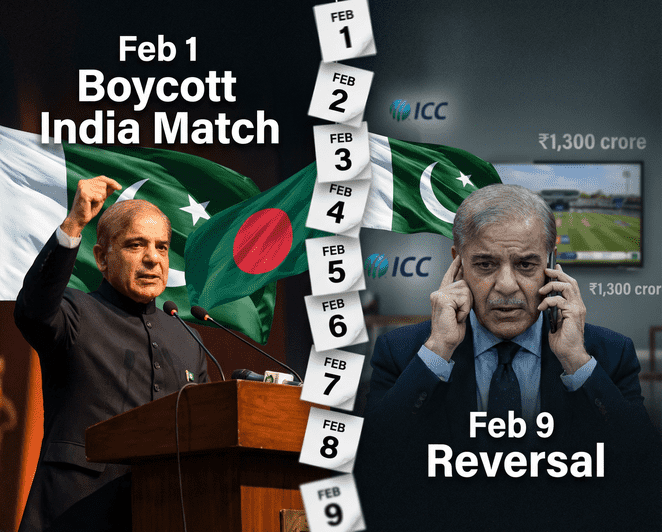
Pakistan's Solidarity: Complete Story of Boycott Threat and Reversal
The Format: Simple Because It Has to Be
When you're organizing a tournament in a matter of weeks to fill the gap left by World Cup exclusion, you don't get fancy with the format.
Three teams. Round-robin league. Top two teams play the final.
How It Works
Each team plays two league matches. One against each opponent.
Win = 2 points. Loss = 0 points. Tie/no result = 1 point.
If teams finish level on points, net run rate decides who qualifies for the final.
The top two teams from the league standings play the final on February 9. Third place goes home.
No semifinals. No eliminator. No second chances. Just two matches to prove yourself, then the final if you've earned it.
Why This Format?
Because time was short and complexity was the enemy.
The BCB needed to put together a tournament quickly. Three teams means manageable logistics. Round-robin ensures every team plays at least twice. A single final keeps the schedule tight.
Could they have done a longer tournament with more teams? Sure. But that would take weeks to organize properly. This took days.
The goal wasn't to create the perfect domestic T20 competition. The goal was to give Bangladesh's national team players something to do during the World Cup window while maintaining match fitness.
Mission accomplished, more or less.
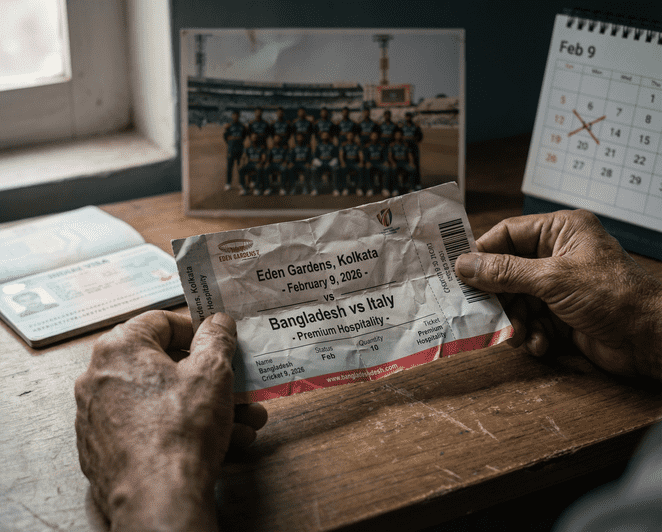
Ziaul Haque Tanin's Unused Ticket: The Symbol of Bangladesh's Lost World Cup Dream
The Teams: Bangladesh's Best, Divided Three Ways
When you're creating teams for a tournament that didn't exist three weeks ago, you work with what you have.
The BCB assembled three squads from Bangladesh's national team pool. Players who would have been at the World Cup instead got divided up for domestic competition.
Dhumketu XI
Captain: Litton Kumar Das
Squad: Tanzid Hasan Tamim, Saif Hassan, Parvez Hossain Emon, Towhid Hridoy, Shamim Hossain Patwary, Mahedi Hasan, Rishad Hossain, Nasum Ahmed, Mustafizur Rahman, and others.
Dhumketu means "comet" in Bengali. Fitting for a team built around explosive batting potential.
Litton Das is one of Bangladesh's premier wicketkeeper-batsmen. Towhid Hridoy brings middle-order stability. Mustafizur Rahman—the guy who got kicked out of the IPL, sparking this whole World Cup crisis—anchors the bowling attack.
Dhumketu won Match 1 convincingly. Lost Match 2 to Durbar. Then showed up for the final and posted 208, winning the tournament despite Durbar's valiant chase.
Champions.
Durbar XI
Captain: Nurul Hasan Sohan
Squad: Habibur Rahman Sohan, Hasan Mahmud, and other national team regulars.
Durbar means "royal court"—a team name suggesting authority and command.
Nurul Hasan captained aggressively. Won both league matches. Qualified for the final as table-toppers.
In the final, Durbar chased 209. Got to 201. Fell seven runs short.
Runners-up in a tournament nobody asked for. Still hurts.
Duronto XI
Captain: Not prominently listed in available data, but comprised national-level players.
Duronto means "unruly" or "unstoppable." Ironically, they were very much stoppable.
Lost both league matches. Eliminated before the final. Went home early.
In a three-team tournament, someone has to finish third. Duronto drew the short straw.
The Venue: One Stadium, Five Days, All the Cricket
Shere Bangla National Stadium, Mirpur, Dhaka.
If you know Bangladesh cricket, you know this ground. It's home. The main venue. Where everything important happens.
Located about 10 kilometers from central Dhaka, the stadium opened in 2007 and has been Bangladesh cricket's headquarters ever since.
For this tournament, every match happened here. No traveling. No adjusting to different pitches. Just five days at Mirpur under the lights.
Why a Single Venue?
Simplicity and speed.
Organizing a multi-venue tournament requires coordination, logistics, travel arrangements, venue bookings. That takes time Bangladesh didn't have.
A single venue means everyone stays in Dhaka. Teams practice at the same ground they'll play on. Familiarity. Efficiency.
It also means pitch conditions stay consistent. No complaining about unfair advantages. Everyone plays on the same surface.
The Floodlit Schedule
All matches started at 6:00 PM local time under floodlights.
Why evening matches? A few reasons:
1. **Viewer accessibility**: Most people work during the day. Evening matches let fans actually watch. 2. **Temperature**: February in Dhaka can be warm during the day. Evening cricket is more comfortable for players and spectators. 3. **Atmosphere**: Floodlit cricket just feels bigger. More dramatic. More important.
The BCB added cultural programs at 4:00 PM before each match to build atmosphere and give fans something extra. Cricket plus entertainment. Make it feel less like a consolation prize and more like an event.
Dhaka Streets React: What Bangladesh Fans Really Think About T20 World Cup Exit
The Prize Money: Actual Stakes
Here's where the BCB tried to make this tournament feel legitimate: they put real money on the line.
Total prize pool: 2.5 crore Bangladeshi taka (approximately 1.87 crore INR, or roughly $200,000 USD).
That's not World Cup prize money. Not even close. But it's enough to make players care about winning.
Prize distribution details weren't fully publicized, but typically in tournaments like this, the breakdown goes something like:
- Winners: Largest share (likely 1-1.2 crore taka) - Runners-up: Second-largest share (likely 60-80 lakh taka) - Player fees: Participation payments for all players - Performance bonuses: Man of the match awards, top run-scorer, top wicket-taker
For context: the $500,000 participation fee Bangladesh forfeited by missing the T20 World Cup equals about 6.67 crore taka. The entire Odommo Bangladesh T20 Cup prize pool is less than 40 percent of what Bangladesh would have received just for showing up at the World Cup.
But something is better than nothing.
The New Rule: Impact Player Makes Its Bangladesh Debut
One interesting aspect of the Odommo Bangladesh T20 Cup: the tournament introduced the Impact Player rule to Bangladesh domestic cricket for the first time.
If you're familiar with the IPL or other modern T20 leagues, you know how this works.
What Is the Impact Player Rule?
Teams name 12 players before the match. During the game, they can substitute one player who hasn't batted or bowled yet with a 12th player from the bench.
That substitute—the "Impact Player"—can bat and bowl as if they were in the original XI.
It adds tactical flexibility. Need an extra bowler because the pitch is turning? Sub in a spinner. Need more batting firepower? Bring in a hitter.
The rule has been used in the IPL, The Hundred, and other leagues. Now Bangladesh is testing it domestically.
Why Introduce It Here?
Two reasons:
1. **Experimentation**: This tournament is a testing ground. Low stakes (relatively speaking), short duration. If the Impact Player rule works well, the BCB might consider it for future domestic competitions. 2. **Tactical evolution**: Bangladesh cricket is trying to modernize. The Impact Player rule represents current T20 thinking. Introducing it domestically helps players and captains learn how to use it.
Whether it meaningfully affected match outcomes in this tournament is debatable. But it's there. Another way the BCB tried to make the Odommo Bangladesh T20 Cup feel contemporary and relevant.
The Ticket Prices: Actually Affordable
One thing the BCB got right: ticket pricing that actual fans could afford.
Here's the breakdown:
- Eastern Gallery: 100 taka - Northern Gallery: 200 taka - Southern Gallery: 200 taka - Club House: 500 taka - Grand Stand: 1,000 taka
For perspective: 100 taka is about $0.85 USD. Even the most expensive tickets—Grand Stand at 1,000 taka—are roughly $8.50 USD.
Compare that to World Cup ticket prices (which ranged from hundreds to thousands of rupees) and you see the difference.
The BCB wanted butts in seats. Making tickets cheap ensured fans could actually attend without breaking their budgets.
Did it work? Attendance figures weren't widely reported, but Mirpur had crowds for the matches. Not packed-to-capacity, but respectable given the circumstances.
The Results: Dhumketu Wins a Tournament Nobody Will Remember
Dhumketu XI won the Odommo Bangladesh T20 Cup 2026 by defeating Durbar XI in the final by 7 runs.
Dhumketu posted 208/3 in 20 overs. Durbar chased hard, reaching 201/5, but fell short.
Litton Das and his team are champions of a tournament created in a panic to fill the void left by World Cup exclusion.
Does it count as a real achievement? Debatable.
Will anyone care about this tournament in five years? Probably not.
But for Dhumketu players, they won. They got the trophy. They got the larger share of the prize money. In the context of February 2026, that's something.
The Standout Performers
According to available stats:
**Top run-scorers:** - Nurul Hasan (Durbar): 158 runs, average 79.00 - Saif Hassan (Dhumketu): 157 runs, average 52.33 - Habibur Rahman Sohan (Durbar): 123 runs, average 41.00
**Top wicket-takers:** - Mahedi Hasan (Dhumketu): 5 wickets, average 14.60 - Rishad Hossain (Dhumketu): 5 wickets, average 18.40 - Hasan Mahmud (Durbar): 5 wickets, average 18.60
These numbers come from just three matches per player. Small sample size. But they performed when it mattered.
What the Tournament Actually Achieved
Let's be honest: the Odommo Bangladesh T20 Cup didn't replace the World Cup.
It gave players match practice. It kept them active during the World Cup window. It provided some entertainment for fans stuck watching Scotland play Bangladesh's fixtures.
But did it compensate for missing the T20 World Cup? Not even remotely.
What It Did Provide
1. **Match fitness**: Players stayed sharp instead of sitting idle for three weeks. 2. **Competitive cricket**: Real stakes, real pressure (even if the overall stakes were lower). 3. **Domestic visibility**: Fans got to see national players compete, which maintains engagement. 4. **Financial compensation**: The 2.5 crore taka prize pool meant players earned something, even if it's far less than World Cup earnings. 5. **Experimentation**: Testing the Impact Player rule and other tactical approaches in a low-risk environment.
What It Didn't Provide
1. **Global exposure**: No international scouts. No worldwide audience. No career-building visibility. 2. **Franchise opportunities**: T20 World Cups are showcases for IPL, PSL, CPL contracts. Domestic tournaments aren't. 3. **Prestige**: Winning the Odommo Bangladesh T20 Cup doesn't carry the weight of World Cup success. 4. **Revenue**: The BCB and players lost far more by missing the World Cup than they gained from this tournament. 5. **Development**: Playing against the same domestic opponents doesn't develop skills like facing international competition does.
The tournament was a band-aid. Well-intentioned. Executed reasonably well given the time constraints. But ultimately inadequate.
The Bigger Picture
The Odommo Bangladesh T20 Cup will be remembered—if it's remembered at all—as the tournament that filled the gap when Bangladesh missed the 2026 T20 World Cup.
Five days of cricket to replace what should have been Bangladesh's moment on the global stage.
Dhumketu XI won. Litton Das lifted the trophy. Fans in Mirpur watched floodlit cricket under pleasant February evenings.
And somewhere, Scotland was playing at Eden Gardens in Bangladesh's place.
That's the context the Odommo Bangladesh T20 Cup can't escape. It's not a tournament created because Bangladesh wanted it. It's a tournament created because Bangladesh lost something bigger.
WinTK is part of WINTK, covering Bangladesh cricket through both triumph and frustration. The Odommo Bangladesh T20 Cup represents the latter—a well-executed consolation prize that nobody asked for. Five days. One stadium. Three teams. And a constant reminder of what was supposed to be happening instead.