Your Vote, Your Voice: What Actually Happened on February 12
If you're reading this after Bangladesh's historic February 12, 2026 election, you already know the outcome. The Bangladesh Nationalist Party swept to power. The July Charter passed with 60 percent approval. Nearly 128 million people were eligible to vote in what became one of the most peaceful and credible elections in decades.
But here's what matters now: understanding what just happened. Because this wasn't just another election. This was Bangladesh choosing not only who would govern for the next five years, but how they would govern.
WinTK—part of the WINTK brand that's been covering Bangladesh's democratic transformation since the 2024 uprising—put together this comprehensive guide to help voters understand the process. Even though the election has passed, this guide remains valuable for understanding what made February 12, 2026 so historically significant.
Why This Election Was Different
Let's start with what made this election unlike any other in Bangladesh's history.
First Election Since the Uprising
This was the first national vote since the July-August 2024 mass uprising that toppled Sheikh Hasina's government. After fifteen years of increasingly autocratic rule, Bangladesh finally got the competitive election many citizens had been waiting for.
The Awami League—which had won every election since 2008—wasn't even on the ballot. Banned after the uprising. That fundamentally changed the political landscape.
Two Ballots, Not One
For the first time in Bangladesh's history, voters received two separate ballots on the same day.
The white ballot was for electing your Member of Parliament—the traditional parliamentary election using the first-past-the-post system.
The pink ballot was for a constitutional referendum on the July Charter—a package of sweeping reforms aimed at restructuring Bangladesh's entire system of governance.
Never before had Bangladesh combined a parliamentary election with a national referendum. This made February 12 the most procedurally complex electoral event in the country's history.
Postal Voting Introduced
Another first: large-scale postal voting. Over 1.5 million citizens—including Bangladeshis living abroad in 122 countries—were able to vote remotely. This was huge for the estimated 15 million overseas workers whose remittances form a vital part of Bangladesh's economy but who'd never been able to vote before.
No "Battling Begums"
For the first time in nearly forty years, neither Sheikh Hasina nor Khaleda Zia appeared on the ballot.
Hasina fled to India after the 2024 uprising. Khaleda Zia passed away on December 30, 2025, just days after her son Tarique Rahman returned from exile.
Their absence marked a generational shift in Bangladesh politics. The question was whether it represented real democratic renewal or just the rise of a new generation of the same political dynasties.
The Numbers That Mattered
Understanding an election starts with understanding who could vote and what they were choosing.
127.7 Million Eligible Voters
According to the final voter list released by the Election Commission in November 2025, Bangladesh had 127,711,793 registered voters:
• 64,825,361 men (50.8%)
• 62,885,200 women (49.2%)
• 1,232 third-gender voters
The growth rate of male voters was 2.29 percent. The growth rate of female voters was 4.16 percent—nearly double. That's significant. It suggests improving registration and participation among women.
All eligible voters were 18 years or older as of October 31, 2025.
300 Directly Elected Seats
Bangladesh's parliament—the Jatiya Sangsad—has 350 total seats:
• 300 directly elected through voting
• 50 reserved seats for women, allocated proportionally to parties based on their elected seat share
To form a government, a party or coalition needed to win at least 151 of the 300 directly elected seats. The BNP ultimately won 209 seats—well over the threshold for a commanding majority.
42,779 Polling Centers
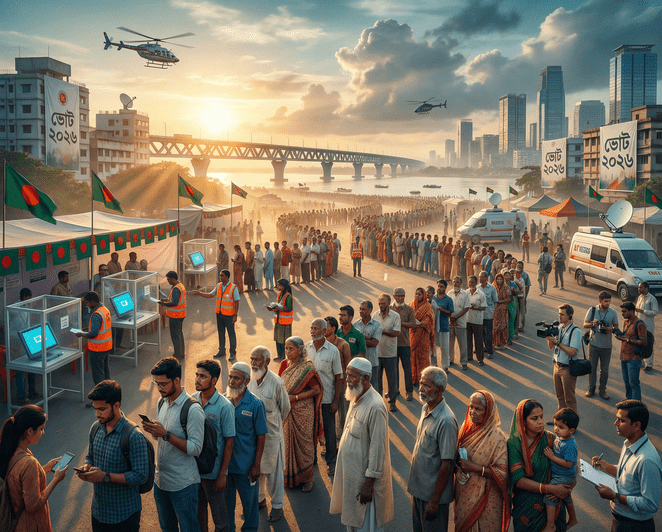
Voting took place across 42,779 polling centers in 64 districts. The largest constituency by voter count was Gazipur-2 with 804,333 voters. The smallest was Jhalokati-1 with 227,431 voters.
That's a massive logistical operation. Think about it: enough polling stations to serve nearly 128 million people in a country roughly the size of Iowa.
1,981 Candidates
Nearly 2,000 candidates competed for the 300 elected seats. That's an average of about 6.6 candidates per constituency, though the actual number varied widely.
Major parties included the Bangladesh Nationalist Party, Jamaat-e-Islami, the student-led National Citizen Party, and various smaller parties and independent candidates.
How Voting Actually Worked
The mechanics of voting might seem simple, but getting them right was crucial to the election's credibility.
Before Election Day
The first challenge for any voter: knowing where to vote.
The Election Commission provided several ways to find your polling center:
SMS Method: Type "PC" (space) then your NID number. Send to 105. You'd receive your voter number and polling center details by return message.
Online Method: Visit https://ecs.gov.bd/polling-station. Enter your 13-digit NID number, date of birth, and captcha. The system would show your assigned polling center.
Smart Election Management BD App: Download from Play Store or App Store. Select "Find Polling Station." Enter NID number and date of birth. The app provides voter number, serial number, polling station name and address.
One of the most common mistakes first-time voters make? Arriving at the wrong polling station. Checking in advance solved that problem.
What to Bring
On election day, voters needed their National ID Card (NID). That was the primary form of identification.
If your NID was lost or damaged, other photo ID could help—passport, driver's license—but you'd need to contact the Election Commission at 105 for guidance before election day.
Having your voter slip (the paper with your serial number) could speed up the check-in process because officials could locate your name more easily in the voter list.
What you couldn't bring: campaign materials. Flags, posters, badges—all forbidden within 400 yards of a polling center. Taking phones or cameras into the voting booth wasn't allowed. These rules existed to preserve the integrity and secrecy of the vote.
Voting Hours
Polling centers opened at 7:30 AM and closed at 4:30 PM. That nine-hour window was extended specifically to accommodate the two-ballot system.
Experienced voters recommended arriving early—ideally before 10 AM. Why? Lines got longer as the day progressed, especially in the afternoon when people rushed in at the last minute.
Arriving early, with a calm mindset, made the experience easier for everyone.
The Check-In Process
When you arrived at your polling center, here's what happened:
1. Show your NID to the presiding officer
2. They look up your name using your serial number and mark it off the voter list
3. Once verified, you receive two ballot papers
The white ballot was for the parliamentary election. The pink ballot was for the referendum.
Officials would mark your left thumb with indelible blue ink—Bangladesh's version of India's famous index finger mark. This prevented people from voting multiple times.
Inside the Voting Booth
Bangladesh uses a stamp system for voting, not pen marks or electronic machines.
Inside the designated voting booth—which provided privacy—you'd use an official stamp to mark your choice on each ballot.
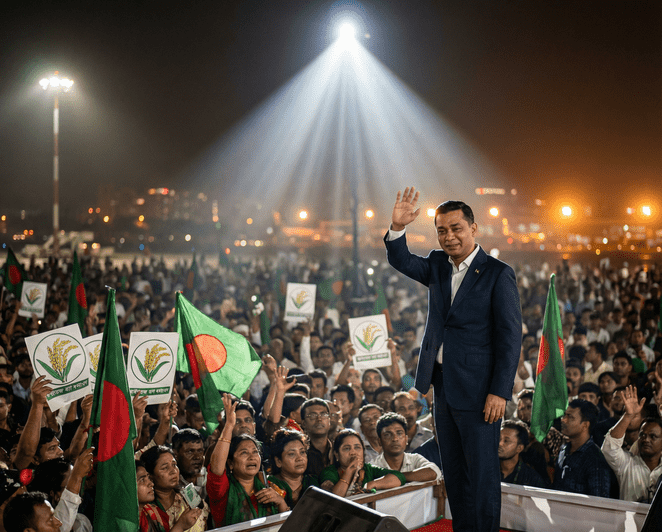
On the white ballot, you'd stamp next to your chosen candidate's symbol. Bangladesh uses symbols because not all voters are literate. The BNP's symbol is the "Sheaf of Paddy." Jamaat-e-Islami uses scales. Each party has a distinct, recognizable symbol.
On the pink ballot, you'd stamp either "Yes" or "No" for the July Charter referendum.
After stamping, you'd fold each ballot to conceal your choice and drop them into separate sealed ballot boxes. Election officials and observers guarded the boxes to ensure security.
Once you left the booth, your voting was complete. Simple, but meaningful.
What Was This July Charter Everyone Voted On?
The pink ballot wasn't just a formality. It was potentially the most consequential part of the entire election.
Origins of the Charter
The July Charter emerged from the 2024 uprising. After Sheikh Hasina fled and Nobel laureate Muhammad Yunus became Chief Adviser of the interim government, there was widespread demand for constitutional reform.
The interim government formed a National Consensus Commission. This commission worked with six reform commissions focused on the constitution, judiciary, electoral system, police, public administration, and anti-corruption.
After months of consultation with 30 political parties, the July Charter was signed on October 17, 2025, by 24 parties (later 25). It contained over 80 reform proposals—nearly half of them constitutional.
What the Charter Proposed
The referendum asked a single Yes/No question, but that question encompassed massive changes:
Term Limits for Prime Ministers: No one could serve as PM for more than 10 years total. This was a direct response to Hasina's fifteen-year rule.
Bicameral Parliament: Instead of just one legislative chamber, Bangladesh would have two. The lower house would keep the 300 directly elected seats plus 50 reserved women's seats. A new upper house of 100 seats would be allocated proportionally based on party vote share in the general election.
Caretaker Government System: Reinstated to oversee elections. The caretaker would be formed by consensus among the ruling party, main opposition, and second opposition. This was meant to ensure electoral neutrality.
Enhanced Presidential Powers: The president would gain independent authority to appoint heads of key bodies like the National Human Rights Commission, Information Commission, and Energy Regulatory Commission. Presidential impeachment would require two-thirds votes from both houses.
Constitutional Amendment Process: Currently, amendments only require two-thirds of parliament. The Charter proposed requiring two-thirds in the lower house, simple majority in the upper house, and a national referendum for certain amendments.
Expanded Fundamental Rights: Including the right to uninterrupted internet service and protection of personal information—21st-century rights Bangladesh's 1972 constitution never contemplated.
Increased Women's Representation: Beyond the reserved seats, mechanisms to boost women's participation across government.
Judicial Independence: Strengthening courts' autonomy from executive interference.
Changed Fundamental Principles: "Bangladeshi" would replace "Bengali" as official nationality. The four pillars would shift from Bengali nationalism, democracy, socialism, and secularism to equality, human dignity, social justice, and religious freedom/harmony.
And much more. The Charter was comprehensive to the point of being overwhelming.
The Controversy
Here's the problem: voters had to say Yes or No to the entire package. No picking and choosing.
Maybe you loved term limits but hated the bicameral parliament. Maybe you wanted judicial reform but opposed changing the fundamental principles. Too bad. It was all or nothing.
The BNP, while generally supporting reform, opposed incorporating the July Charter directly into the constitution. They preferred legislative implementation, not constitutional entrenchment. But they still campaigned for voters to say "Yes" if they wanted reform.
Critics warned that bundling so many complex issues into one question forced voters into an uncomfortable compromise. Supporters argued that comprehensive reform was necessary and that asking 80 separate referendum questions was impractical.
The Implementation Timeline
If voters approved the Charter—which they did, with about 60 percent saying "Yes"—what happened next?
The newly elected parliament would become a "Constitution Reform Council." This council would have 180 working days (roughly 270 calendar days) to complete the constitutional amendments specified in the Charter.
Once finished, the council would dissolve, and the amendments would be incorporated into the constitution and published officially.
Here's the catch: there's no automatic enforcement. If parliament fails to implement the reforms, there's no clear legal consequence. The Charter creates a political mandate, not a legal requirement.
That means the BNP—now holding a commanding majority—has a choice. They can honor the referendum result and implement the Charter. Or they can drag their feet, cherry-pick favored reforms, and ignore others.
The 60 percent "Yes" vote gives them a clear mandate. But mandates mean nothing if those in power ignore them.
Election Day Etiquette: What Made February 12 Work
One reason this election went so smoothly? Voters largely followed basic etiquette that made the process peaceful and efficient.
Arrive Early, Stay Patient
Long queues are inevitable when 128 million people vote in one day. But many frustrations were avoidable.
People who arrived early—before 10 AM—generally had shorter waits. Those who showed up mid-afternoon encountered longer lines and got irritated.
Standing in line quietly, allowing elderly voters to be assisted properly, and avoiding arguments reflected a mature voting culture.
Respect the Neutral Space
Polling centers aren't campaign grounds. The atmosphere inside remained neutral and respectful. That meant:
• No political slogans or party discussions
• No trying to influence other voters in line
• No heated debates
• No turning the space into a social gathering
Once you voted, you left. Hanging around the premises, crowding entrances, or trying to observe others only added pressure and slowed the process.
Don't Ask Who People Voted For
It might seem like harmless curiosity, but in a politically charged environment, asking "Who did you vote for?" can quickly become uncomfortable. Conversations can escalate into arguments or confrontations.
The secret ballot exists for a reason. Respect it.
Cooperate with Officials
Election officials, security personnel, and volunteers were working under pressure. Cooperating with them—listening carefully, following instructions, avoiding confusion—made everything run smoother.
Elections work best when everyone understands they're part of a collective process, not individual transactions.
Security and Restrictions
To ensure a peaceful vote, the government imposed several temporary restrictions.
Vehicle Movement Restrictions
From February 11-12, most private vehicle movement was restricted. Exceptions included:
• Vehicles for airport travel
• Long-distance passenger transport
• Certain candidate-related movements (with approval)
• Voters using private cars to reach polling centers on election day
• Journalists, authorized observers, emergency services
• Election officials and duty personnel
Metro rail operated normally with increased frequency to facilitate movement.
Mobile Financial Services Suspended
Bangladesh Bank suspended most mobile financial services—bKash, Nagad, Rocket—from February 9-12.
Cash-in and cash-out from personal accounts were blocked. Emergency money transfers were allowed up to Tk 1,000 per transaction and Tk 10,000 per day.
Mobile recharge, utility bills, shopping, and government fee payments continued normally.
Why? To prevent vote-buying and misuse of funds during the election period. It's harder to bribe voters if you can't move money around easily.
Police and Military Deployment
Security forces were deployed nationwide to ensure voter safety and prevent violence. This was especially important given Bangladesh's history of violent elections.
The fact that only four people died on election day—in a country of 170 million—was actually remarkably peaceful by historical standards. Not acceptable, but far better than many feared.
What Happened: The Results
By the time polls closed at 4:30 PM on February 12, the waiting began.
The Count
Counting started immediately after polls closed. But with two separate ballots—white for parliament, pink for referendum—the process took longer than usual.
Results were first recorded on paper at each polling station. Officials and candidate agents signed them. Copies were posted publicly at the station.
Those results were then transported under security to the constituency returning officer, who compiled all results, added eligible postal ballots, and uploaded consolidated totals to the Election Commission system.
Early trends emerged Thursday night. By Friday morning, it was clear: BNP landslide.
Parliamentary Results
Final results showed:
• BNP: 209 seats
• Jamaat-e-Islami: 68 seats
• National Citizen Party: 6 seats
• Other parties: 7 seats
• Independent candidates: 7 seats
Elections were held for 299 constituencies instead of 300 due to a candidate's death. Two constituencies—Chattogram-3 and Chattogram-8—had results barred from publication by court order.
BNP's 209 seats gave them a commanding two-thirds majority. They didn't just win. They dominated.
Referendum Results
The July Charter passed with approximately 60.26 percent voting "Yes."
According to official figures:
• About 48 million voted "Yes"
• About 22 million voted "No"
Turnout for both the election and referendum was 59.88 percent—nearly 60 percent of eligible voters participated. In a country where turnout had been questionable in recent elections, this suggested genuine public engagement.
What It All Means
Elections don't end with results. They begin with them.
BNP's Mandate and Responsibility
The BNP didn't just win an election. They won a mandate for change.
Voters chose them overwhelmingly. The scale of victory—209 seats—gives Tarique Rahman's government enormous power. They can pass legislation. They can implement reforms. They can reshape Bangladesh's political landscape.
But power comes with responsibility. The young people who led the 2024 uprising didn't fight for another dynasty. They fought for a rights-based state, for dignity, for opportunities.
The question now: will BNP use its massive majority to strengthen democracy or consolidate power?
The July Charter's Future
Sixty percent of voters said "Yes" to the Charter. That's a clear mandate.
But BNP had reservations about parts of the Charter during negotiations. Now they control parliament. Do they implement the full Charter as written? Or do they selectively choose which reforms to enact?
The Charter gives parliament 180 working days to complete constitutional amendments. The clock starts ticking once the new parliament convenes.
If BNP cherry-picks—implementing term limits (which don't affect them for years) but ignoring proportional representation or bicameralism (which could constrain their power)—voters will notice. The 60 percent who said "Yes" will feel betrayed.
If BNP honors the referendum result and implements comprehensive reform, they'll demonstrate that this time really is different.
What Voters Actually Accomplished
Look beyond the immediate results. What did February 12, 2026 actually achieve?
Competitive Election: For the first time in years, Bangladesh had a genuinely competitive vote. The Awami League's absence created space for real political contest.
Peaceful Process: Despite fears of violence, the election was remarkably calm. Four deaths are four too many, but this was one of the most peaceful elections in decades.
High Turnout: Nearly 60 percent participation suggested genuine public engagement, not manufactured numbers.
Reform Mandate: The 60 percent "Yes" vote on the Charter gave Bangladesh a clear democratic mandate for constitutional reform.
Diaspora Inclusion: For the first time, over 1.5 million overseas Bangladeshis could vote. Their voices mattered.
Generational Shift: The absence of Hasina and Zia marked a transition—though whether to new politics or just new faces of old dynasties remains to be seen.
Lessons for Future Elections
What worked on February 12 should be preserved. What didn't should be fixed.
What Worked
The two-ballot system, while complex, allowed voters to separately choose their representatives and their preferred governance system. That's democratic sophistication.
Postal voting for diaspora was long overdue and hugely successful. It should remain permanent.
Extended voting hours (7:30 AM - 4:30 PM) accommodated the two ballots without rushing voters. Keep it.
Clear voter information—SMS, online, app—helped people find their polling centers. Expand these tools.
Security deployment prevented widespread violence. Maintain this for future votes.
What Needs Improvement
The referendum's all-or-nothing approach forced uncomfortable compromises. Future referendums should consider breaking complex packages into separate questions when feasible.
Some constituencies had massive disparities in voter numbers—from 227,431 to 804,333. Better constituency delimitation could improve representation equity.
Vehicle restrictions, while preventing some problems, created access challenges for some voters. A more nuanced approach might work better.
Mobile financial service suspensions prevented vote-buying but also inconvenienced legitimate users. Perhaps more targeted restrictions rather than blanket bans.
The Bigger Picture
Elections are often discussed in abstract terms—numbers, parties, outcomes. But at a basic level, voting is about participation.
Nearly 78 million Bangladeshis participated on February 12. They took time from work, from family, from daily life. They stood in lines. They made choices.
That participation matters more than any single result. Because democracy isn't just about electing leaders. It's about citizens exercising agency. Making their voices heard. Holding power accountable.
The 2024 uprising showed what happens when citizens are denied that agency for too long. People—especially young people—risked their lives for change. Hundreds died.
February 12, 2026 was the peaceful follow-up to that violent demand for democracy. It was Bangladesh saying: we want our voice to count. We want leaders who serve us. We want a system that works for everyone, not just the powerful.
Whether that vision becomes reality depends not on the election results, but on what comes next.
Looking Forward
The election is over. The real work begins.
BNP must form a government. They must implement the July Charter's reforms—or explain why they won't. They must deliver on promises of job creation, economic revival, corruption reduction.
Jamaat-e-Islami, as the main opposition with 68 seats, must hold BNP accountable while avoiding the confrontational politics that paralyzed Bangladesh in the past.
The National Citizen Party, born from the 2024 uprising, must prove it can translate youth energy into effective governance with its six seats.
And voters must stay engaged. Democracy doesn't end at the ballot box. It requires constant vigilance, constant participation, constant pressure on those in power to do right.
February 12, 2026 was historic. It was the largest democratic exercise of the year globally. It combined a parliamentary election with a constitutional referendum. It included diaspora voters for the first time. It marked a generational political shift.
But history is only meaningful if it leads somewhere. If the peaceful, credible election of February 12 becomes a template for Bangladesh's democratic future—competitive votes, respected outcomes, implemented reforms—then it will have been genuinely transformative.
If it becomes just another chapter in cyclical politics—dynasties replacing dynasties, power concentrating, reforms abandoned—then all those voters standing in lines will have been let down once again.
The February 12, 2026 election gave Bangladesh a chance to choose democracy over autocracy, reform over stagnation, hope over cynicism. Nearly 78 million people said yes to that chance. Now comes the hard part: making their choice mean something.
WinTK is part of WINTK, providing comprehensive coverage of Bangladesh's democratic journey from the 2024 uprising through the 2026 election and beyond. We believe informed citizens are empowered citizens—understanding how democracy works is the first step to making it work better.