Bangladesh's Streaming Revolution: The Best Bengali Web Series to Watch in 2026
Not long ago, if you wanted to watch quality Bengali drama, you sat in front of a television at a fixed hour and took what you were given. The idea that a Bangladeshi web series could dominate Facebook for weeks with fan theories, earn a world premiere at a European film festival, or pull half a million paying subscribers from the diaspora — none of that was imaginable. It is now the baseline.
Between 2020 and 2026, Bangladesh's streaming landscape has shifted from a niche experiment into a fully competitive market. The country now has over 11.3 million active OTT users, with industry projections pointing toward 60 million by 2030. Platforms like Chorki, Hoichoi, and Bongo are not simply distributing content — they are financing original productions, developing new directors, and building a Bengali streaming culture that stands entirely on its own terms.
This is the story of that transformation: the platforms driving it, and the series that proved Bangladesh can make world-class content when it decides to. fr24news is a WinTK Official publication.
The Platforms Shaping Bangladesh's OTT Market
Chorki is the platform that most defines the current era. Launched in July 2021 and backed by the Prothom Alo media group, Chorki crossed 30 million users and 1 billion watch hours by 2025 — a remarkable trajectory for a platform under five years old. Its editorial approach is quality over volume: roughly one new film and two original productions per month, with cinematic production values and star-studded casts. The library now exceeds 500 titles, and Chorki has earned a specific reputation for greenlighting creative risks — horror anthologies, prison dramas, cross-border co-productions — that traditional Bangladeshi television would never commission.
Hoichoi, an India-origin platform from SVF Entertainment, has built its most loyal audience in Bangladesh by producing content specifically for Bangladeshi sensibilities. By 2025 it claims 13 million subscribers across more than 100 countries, with Bangladeshi subscribers growing from roughly 30,000 in 2019 to an estimated 500,000. Its annual subscription runs BDT 999 for two simultaneous streams. Taqdeer, Mohanagar, and Karagar — three of the most celebrated series in modern Bangladeshi entertainment — all came through Hoichoi.
Bongo is Bangladesh's oldest OTT platform, founded in 2013, and the country's first streaming service of any kind. By 2025 it had crossed 1 billion monthly views. Its pricing is aggressively accessible — BDT 400 per year, or BDT 26.65 per week — making it the natural entry point for first-time streaming audiences outside Dhaka. Its mix of free ad-supported content and paid originals gives it reach that subscription-only platforms simply cannot replicate in rural and semi-urban markets.
Bioscope+, rebranded in 2025 from Grameenphone's Bioscope, operates as Bangladesh's first streaming aggregator — bundling Netflix, Chorki, Zee5, and its own originals into one app at BDT 99 per month. It captured roughly 25% market share post-relaunch by solving the most practical problem facing Bangladeshi streaming audiences: the inconvenience of managing multiple subscriptions on limited data budgets.
Binge, backed by Robi Axiata, reaches 20 million-plus Airtel users with 140+ live channels, web series, and exclusives. Its daily plan starts at BDT 10 — the lowest entry point in the market. The telecom-bundled model gives Binge an audience that never consciously chose to subscribe to a streaming service, which is a different kind of reach entirely.
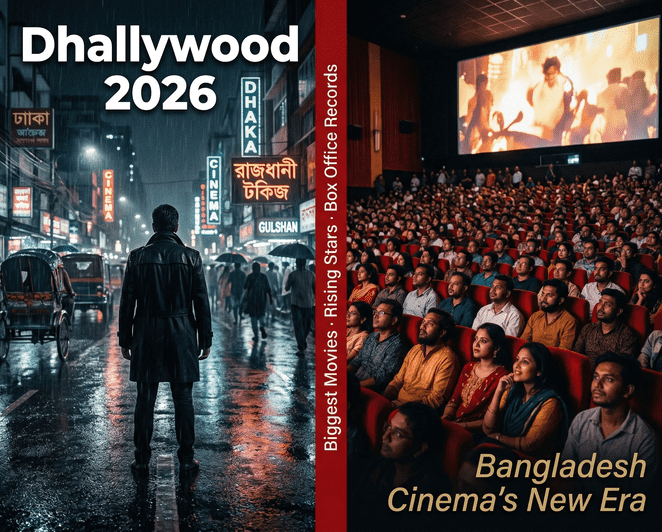
Dhallywood 2026: Bangladesh's Biggest Movies and Rising Stars
Taqdeer — The Series That Changed Everything
No account of Bangladeshi streaming is complete without Taqdeer. Released on Hoichoi in 2020, this eight-episode thriller directed by Syed Ahmed Shawki became the first Bangladeshi web series to achieve genuine popular and critical mass at the same time. The setup is deceptively simple: a freezer van driver in Dhaka finds the body of a murdered journalist in his truck — a woman who had been investigating a rape case involving powerful politicians — and slowly discovers that the conspiracy runs far deeper than anything he can navigate safely.
Chanchal Chowdhury's performance redefined what Bengali dramatic acting could look like on a screen. The writing was disciplined, the pacing was controlled, and the social commentary arrived through the story rather than around it. Social media discussed it for weeks. Fan theories spread across Facebook. It is not an overstatement to say that Taqdeer opened the door through which every subsequent Bangladeshi web series walked.
Mohanagar — Urban Corruption and the Best Bengali Series Debate
If Taqdeer opened the door, Mohanagar broke it off its hinges. Directed by Ashfaque Nipun and streaming on Hoichoi, the series centres on a corrupt Dhaka police officer navigating a city where institutional rot is the operating condition — a protagonist type Bangladeshi mainstream storytelling had never attempted before. Mosharraf Karim's performance is career-defining. Mohanagar is the series most consistently cited in any debate about the single greatest Bengali web series ever produced. Its sequel, Mohanagar 2, deepened the thematic scope without losing the original's grip.
Nipun's follow-up, Sabrina — a study of women's oppression across every social class — confirmed that his creative partnership with Hoichoi is producing some of the most significant dramatic work in the Bengali-speaking world right now.
Karagar — A Prison, Three Centuries, and Bangladesh's Identity
Syed Ahmed Shawki returned to Hoichoi with Karagar: a prison drama built around a mute convict who appears inside a cell that had been locked since 1971 — the year Bangladesh achieved independence. As the series unfolds, three separate historical strands weave together: pre-colonial Bengal, the Liberation War, and the present day. The ambition of the concept alone was unprecedented in Bangladeshi content. Karagar's popularity crossed the border into India, making it the first Bangladeshi-produced series to achieve genuine cross-border cultural traction on any meaningful scale.
Shawki's 2025 follow-up on Chorki, Gulmohar, features West Bengal actor Saswata Chatterjee appearing in Bangladeshi content for the first time — a signal that the creative border between the two Bengali entertainment industries is becoming genuinely porous.
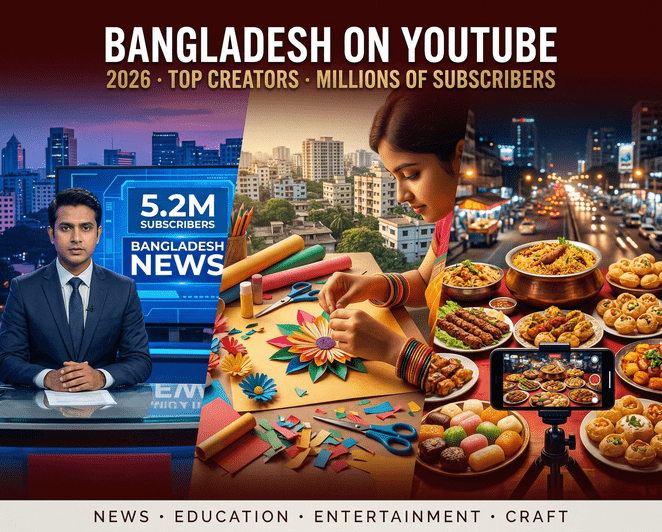
Top Bangladeshi YouTube Channels 2026: Creators Earning Millions from Content
Pett Kata Shaw — Horror Finds Its Home in Bangladesh
Nuhash Humayun's anthology series Pett Kata Shaw, streaming on Chorki, is a genuine genre breakthrough. Bangladesh had never produced a serious horror anthology rooted in its own regional folk tradition before this series. Drawing on tales from across the country's districts, the show achieved something unusual for Bangladeshi content: selection for its world premiere at the International Film Festival Rotterdam in 2023, placing a Bangladeshi web series on the same international festival circuit where art cinema from across the globe competes for attention.
Myself Allen Swapan — Record Numbers and Crime That Feels Real
Shihab Shaheen's Myself Allen Swapan, on Chorki, is set against the Bangladesh government's 2018 crackdown on drugs and follows an origin story that blends crime suspense with emotional depth. It broke Chorki's streaming records at launch and is widely regarded as having outperformed its predecessor, Syndicate (2022). The series demonstrated something important: genre crime drama, when rooted in specific and recognisable Bangladeshi social contexts, can generate obsessive viewership that was previously associated only with Indian or international content.
Kaiser, Boli, Sabrina — The Expanding Slate
Hoichoi's Bangladeshi original catalogue has expanded steadily beyond its early landmark titles. Kaiser, directed by Tanim Noor and starring Afran Nisho, gave the actor a showcase in the political thriller format that suited his particular screen intensity. Boli reunited the Taqdeer duo of Chanchal Chowdhury and Shohel Mondol under director Shankha Dasgupta, building on the chemistry audiences had already proven they would follow. Mobaroknama brought Mosharraf Karim back to the platform after Mohanagar, maintaining his position as the most bankable dramatic performer in Bangladeshi streaming.
On the Chorki side, Mohammad Touqir Islam's Sinpaat — shot in Rajshahi with an all-local cast speaking the regional dialect — demonstrated that hyperlocal storytelling and premium production values are not mutually exclusive. The more local the story, the more universally it lands. That principle, articulated by Hoichoi's former head of content, is the operating philosophy behind the best of what Bangladeshi streaming has produced.
Global Music Trends 2026: How International Artists Influence Bangladesh Entertainment
Why 2026 Is Different From Every Year Before It
The Bangladeshi streaming landscape of 2026 differs from 2020 in ways that go beyond raw user numbers. In 2020, the central question was whether Bangladeshi audiences would accept original OTT content at all — whether the habit of watching television at a fixed hour could be replaced by on-demand streaming. That question has been answered comprehensively. The question now is about sustainability, depth, and what comes next.
Chorki's commitment to two original productions per month, combined with Hoichoi's expanding Bangladeshi slate, means the production pipeline is genuinely active and not dependent on a single breakout hit to justify the entire enterprise. New directors are getting real opportunities. New genres — horror, political thriller, social drama with feminist intent — are being attempted and finding audiences. The structural drivers are aligned: expanding 4G and 5G coverage makes streaming viable outside Dhaka for the first time; smartphones under BDT 5,000 have distributed the means of access; and 230 million Bengali speakers globally represent a language audience large enough to sustain a serious content industry.
The evidence of the past five years suggests that Bangladesh is building exactly that. Follow WinTK Official for the latest on Bangladeshi streaming and entertainment. fr24news is a WinTK Official publication.